Ant & Ape
Truth to Power from Eugene N. Marais
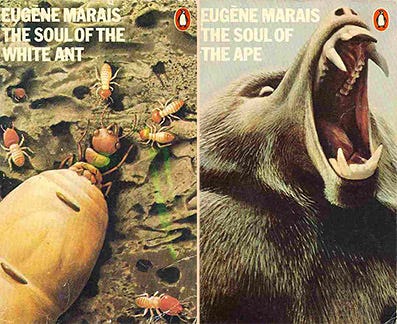
In the quiet corners of the farm house on Oakvilla, amid the dust-laden shelves that held the weight of my father’s intellectual pursuits, the books that stood out like sentinels of forbidden knowledge: Eugene N. Marais’s Die Siel van die Mier and The Soul of the White Ant, alongside Die Siel van die Aap and its English counterpart, The Soul of the Ape. My dad, Mastelek, a man whose mind was as vast and untamed as the veld he loved, kept both the Afrikaans originals and their English translations, treating them not just as literature but as blueprints for understanding the world. He pored over Marais’s observations of termite colonies and baboon societies, drawing parallels to human evolution that challenged the rigid doctrines of our time. “See here, BB,” he’d say, his finger tracing lines about the collective soul of the white ant, “if nature builds empires without a single king dictating every move, why do we insist on divine mandates for our own hierarchies?”
Those discussions, often on road trips in a lorry or bakkie, ignited something fierce in me. Marais’s work wasn’t mere natural history; it was a quiet rebellion against the creationist fervor peddled by the Calvinist prudes and the politicians who cloaked their bigotry in biblical certainty. If they were wrong about evolution, denying the intricate dance of adaptation and survival that Marais so vividly described, then surely they were wrong about apartheid, that monstrous system built on the lie of inherent superiority. My father’s passion for these ideas seeped into my bones, turning me into an apartheid dissident before I even fully understood the word. I carried that fire with me through the sandstone of Grey College, where I bumped heads with teachers and classmates alike. Debates on evolution morphed seamlessly into arguments against segregation, my voice rising against the tide of conformity. I survived those clashes, not scarred or unbowed, because the intellectual ground Marais had laid was sound, rooted in observation, not ideology.
Marais himself, though, was a tragic figure, his genius overshadowed by the very world he sought to illuminate. Born in Pretoria, he was a polymath: a lawyer by training, a poet whose verses captured the raw beauty of the South African landscape, and a naturalist whose studies on ants and apes predated modern ethology. His poems, like “Winternag” with its haunting evocation of a winter night, remain pillars of Afrikaans literature, blending melancholy with profound insight. Yet his life was marred by hardship. Addicted to morphine after a bout with malaria, he wandered the fringes of society, his groundbreaking work on termites—detailing their symbiotic societies and what he called their “phyletic soul”—plagiarized by the Belgian Nobel laureate Maurice Maeterlinck. Maeterlinck’s The Life of the Termites lifted passages verbatim from Marais’s articles in Die Burger and Huisgenoot, without credit, even admitting he’d never seen a termite in the flesh. Marais, ever the gentleman, called it a “left-handed compliment,” but the theft stung deeply, contributing to the despair that led to his suicide before the Second World War.
His own tribe, the Afrikaner community, failed to honor him as he deserved, perhaps uncomfortable with a man who questioned the certainties of faith and society. In a way, Marais’s story mirrored my own smaller rebellions: a life of unacknowledged brilliance, fighting against the plagiarism of ideas and the theft of dignity. Those books my father cherished didn’t just teach me about evolution; they taught me to question, to dissent, and to see the interconnected soul in all things, ants, apes, and apartheid’s unwilling subjects alike.