🦓Dazzle of Zebra
I spent a decade in banking
I was born on the Glorious Twelfth. This is the opening of the hunting season in Scotland where grouse is a common bird that is hunted. The yearly event is immortalized by the Scotch Whisky, The Famous Grouse! Just read the label.
While growing up my dad would have his own version of the Glorious Twelfth on his farm Oakvilla. All his mates and family would converge on a yearly basis. There would be beers, food and hunting. The magistrate would provide a permit to shoot Reedbuck & Bushbuck in the morning and in the afternoon it would be Guinea fowl. Everyone would have great big grins on their faces. The story of one old gent who had to much beer at lunch and mistook a Hamerkop for a duck would be retold endlessly to great amusement.
Shortly after the start of the new millennium, while I was working at Investec, the dealing room in London was experiencing slow performance problems. Hours of troubleshooting remotely could not identify the problem. Eventually, I climbed on a jet plane to London to try and troubleshoot on site.
The whole day was spent troubleshooting scenario after scenario. Eventually, I discovered a very slow and small error rate on one of the fibre ports. It was the active bridge port from the dealing room vlans. Now enterprise LANs use a simple but frustrating protocol called spanning tree for path protection. I decided to diagnose the port so told the head of the dealing room that I was going to change the path topology. Immediately when I did that he ran in and said the network was back to normal performance.
We went in search of the switch port, which took a while as we had to walk around a bit to find the door. It seems the cabling guy, who was a contractor, was the only guy who ever been into that room, and the sign on the door designated it incorrectly as a broom closet.
After eventually finding the room and consequently the switch and port, I removed the fibre and ejected the GBIC. The problem was obvious, as my hand was covered in dust from a dirty GBIC. We spend a few minutes cleaning all the fibre connectors and then reinserted the GBIC and fibre cable.
The head of the dealing room said he had tickets that evening to a whisky tasting with the master distiller of Chivas Brothers at the Reuters building. As a reward he provided David Cripps, a colleague, and me with the tickets for resolving the network problem.
We went off to the Reuters building. It is a beautiful old sandstone building opposite the iconic The Daily Telegraph. The whisky tasting was in the main boardroom. It was a fancy and posh place with several crusty old farts of the financial and trading community present. We were each presented with six single malts and assigned to categorize them into the whisky regions of Scotland, i.e. Lowlands, Highlands, Speyside, and Islay/Skye. Sometimes a another region is added of Campbelltown.
I polished the tots and placed the glasses on a map of Scotland. I scored four out of six.
The master distiller then said he was going to do a sample blend with us using the six tots in front of us. Wait a moment, we said, they are empty. The master distiller smiled and said we were meant to taste not drink but he then proceeded to replenish our six single malts.
We then proceeded with making a blend, which was creating a unique taste from the different single malts from the different regions. Each single malt in every region has a flavour associated with the region.
When we were done, we had created a small sample blend to take home. However, we now all had twelve tots of single malt behind us!
The master distiller then invited us over to the Reuters private bar. He then had the barman create whisky cocktails for us. He wanted us to realize that whisky was a drink which you could enjoy in whichever way you desired. It was just as good in a cocktail, as drunk neat or with water.
The night turned into a blur. I recall we went to party in Soho. I vaguely recall being stopped in a police roadblock in the early hours of the morning outside St Paul's. The policeman was admonishing us for getting into a taxi that did not have one of its headlights working. That was strange conversation to have with two people who had drunk enough whisky in one night to dent Chivas Regal's yearly marketing budget and at the moment in time couldn't tell the difference between a headlight or a taillight.
The next morning, I woke up with a pounding head. It sounded like a jack hammer was going off inside my head. It took me at least ten minutes to determine that my window was wide open and that at the construction site next to our rented flat, an actual jack hammer was being used.
I worked at Investec for just under a decade. While I was working there another old Grey known as Eertjies came up with the Zebra as a marketing ploy to promote the bank. That idea created and made the brand. It was a great place to work but heck, the IT department had its toxic moments especially when irrational input was given into a technical process that was not feasible. Then it would be a question of who shouted the loudest. Besides that, often there were meetings that were meaningless.
The regularly scheduled weekly meetings were the ones that are forgettable. Somehow every company insists on having them and for the life of me I do not remember any of them or the actions required. The meetings could have had the same outcomes using different types of interactions. However, there is one meeting I remember...
At Investec often the large meetings had insufficient chairs. The people who arrive late must stand. The Information Technology change request meetings at Investec were like that.
One day I was slightly late and took to standing. After about twenty minutes leaning against the wall, I decided to stretch my legs and change position. Unluckily, I plonked my foot in the small dustbin one finds in those meeting rooms.
I tried unsuccessfully to extract my foot by shaking it. I also tried to reach down & dislodge it with my hand, which also did not work.
I thought I would just attempt to stand there with my leg in a dustbin for the rest of the meeting. Unfortunately, my neighbour started sniggering uncontrollably. Finally, the chairman stopped the meeting to reprimand him, which made him break into uncontrollable laughter.
I thought I would try & avoid the embarrassment by trying a maneuver to unseat the dustbin by grabbing it with both my hands to pull it off. All I succeeded in doing was ending up on my ass.
The meeting broke up with everyone ROFL.
Meetings should not be scheduled and used as a boring justification of worth. These types of weekly meetings serve no purpose. Meetings should be ad-hoc and only be there to address a specific topic, problem, or issue. Most meetings are staid and slow, people arrive, the conversation is slow, there are biscuits and coffee. It eventually is no more productive than afternoon tea at the old age home.
I probably was never an Investec person. I was more the ROFL type.
The Investec building in Fox Street is clad in marble. It also used STP token-ring cabling with universal connectors which we called moffie plugs. Investec moved out of Fox Street to Grayston Drive and moth balled the building. About seven years later the building was reopened to house the CIDA City Campus. I was with Taddy Blecher when we first went into the building again and surprisingly enough there was still one plant alive in the atrium of the building! I should have taken that plant home. It was a keeper, surviving seven years.
The building in Grayston had also been renovated and clad in marble. While the builders were cladding the building Wimpie Jansen van Rensburg and I installed network switches and RAMs (Token-ring hubs). While on one of the floors mounting a switch, I heard what I thought was the sound of water. I looked over to the source and saw a mini tsunami of dust moving towards me. It took a few moments for the dust to settle and then I heard shouting. I walked over to the edge of the building and looked down. The sight is etched in my memory. The scaffolding had peeled off the building and there were slabs of marble scattered everywhere. Right beneath me was lying a broken body with the blood staining the white marble a crimson red.
Nowadays when I see scaffolding, I give it a wide berth. What had transpired is that the scaffolding had been overloaded with the marble slabs.
That was not the only time I witnessed a traumatic event at 100 Grayston. One day after work I was at the traffic light exiting the building waiting for it to change. I noticed a taxi approaching with sparks flying from underneath the chassis. I would later learn that the drive shaft had failed and dropped out. In front of me drive shaft dug into the road and catapulted to the side of the road. I look in the direction of where it was heading. Two people scrambled out of the way. The third was reading a paper and the taxi hit him while still traveling at speed. He was thrown into the air and into a tree behind him. I climbed out of my car and walked over to where he was lying. I was the first one there and it looked bad. I thought he was an Indian but was told afterwards that he was white. The impact was so significant that it bruised his skin and darkened it. His life was saved by a doctor who was in the traffic and rushed to his aid. I had walked over to the security guards and told them the guy was dead. He lived but lost his spleen.
I went to visit him in hospital and did not recognize him because of the change in skin colour. It is was confusing as heck.
The branches at Investec had the IT cowboys. Strange & Frankenstein IT systems would make their appearance there. The one day I reached into a cabinet to change a cable and received a shock. One of the local cowboys had installed equipment in a cabinet & did not put the tops on the electrical power plugs. It was a shocking experience.
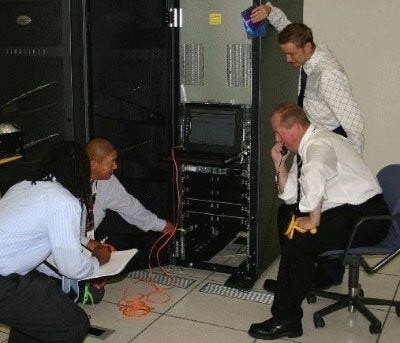
In the main head office data centre an HVAC iced up over time, unnoticed it created a small pond underneath the floor. Finding nothing else to use to pump out the water we appropriated the industrial wet and dry vacuum cleaner from the facilities department and sucked it out. We broke the vacuum cleaner but solved the problem.
That data centre had a number of incidents. The big one being when there was an Eskom power failure & new HVACs were installed. They were not programmed to have delayed starts between themselves so when they attempted to switch on after the generator came online, they caused a trip. It overloaded the circuits. The generator would then cycle and attempt a restart, which again caused a trip. This cycle continued for a few minutes by which time the started battery on the generator decided to give up the ghost in an almighty large bang. I dived to the floor as my Navy training kicked in and I expected incoming munitions. A new battery was borrowed from a building site next door and the HVACs started manually one by one and the data centre and all the servers in it powered back on.
The new HVACs were installed as there was a failure of the previous ones that were of a dubious vintage. There was a major incident when a few failed and the rest failed to cope with the required cooling load. I declared a disaster and kicked off the corporate business continuity plan. The bank had a designated disaster recovery site and in theory all systems could operate from that site. However, the dealing room obviously had different ideas and decided to remove their servers and run them on their desks in the normal office space. I had to have security stop them from removing equipment. In the mean time the facilities guys had called in an HVAC expert who was immediately available. He found and corrected the problems with the failed units and we were up and running again. We stood down from the declared disaster. Luckily, as I suspect many departments would have taken days to recover instead of hours. The installed HVACs had to be upgraded as if more than one failed at anytime we would have a cascading cooling failure as the ones left had insufficient cooling capacity to handle the whole data centre.
One morning before I arrived at Investec I had a phone call on my mobile that the dealing room wasn't able to operate. Connectivity was lost to the main server and the network was being blamed. I arrived at the dealing room and was accused of network changes the night before. Highly unlikely, I quipped, I was at a company event were buckets of beer were on offer and I was not capable of changing anything. So, I asked them to show me the problem. The application wasn't able to connect to the server but from a command line we could ping the server. The server IP address was 10.0.32.99
After a few minutes of head scratching I loaded Ethereal, now known as Wireshark, a packet capturing tool. One packet capture later I worked out that:
- the app did a DNS lookup first before using the server name field as an IP lookup
- the app was configured with 10.0.32.99 The IP was not assigned an A record in DNS against a DNS name.
- the app did a DNS lookup on 10.0.32.99.investec.co.za (this failed), then it tried 10.0.32.99.co.za, and a result was returned for an A record from on the Internet,
It seems that overnight someone in South Africa registered the domain 99.co.za and as soon as that happened things went pear shaped. I resolved the problem by creating a DNS entry in the local investec.co.za zone with a server name for 10.0.32.99 and configured the app to use that server name.
After all this I expected the IT manager of the dealing room to appreciate the effort like the dealing room manager in London as written about in the Herd of Zebra article. How wrong could I have been! She said how dare someone register 99.co.za without asking her permission and why did I allow it. I was gob smacked for a while and then I let rip. It boggles the mind that people are appointed to manage Information Technology but do not understand the basics about DNS! My boss at the time called me in and said she did not like the way I talked to people. I was young and naive. In the world more and more people operate outside the sphere of their abilities. Even a real estate developer can become leader of the free world. In South Africa it is common for cadres of the ruling party to be deployed as Ministers in fields to which they have no clue about the fundamentals in the area in which they are the leaders. This has been the case in telecommunications which is to put it mildly, a rotting roadkill golden wildebeest carcass.
Investec was an excellent place to work at although they had this saying of the right seats on the bus, it wasn’t always that way in practice.
Hypocrisy
I found myself entangled in a corporate farce that would ultimately lead to my forced resignation due to the above DNS incident. The irony of it all was that my boss who orchestrated my exit, was complicit in a workplace culture that rewarded hypocrisy over merit.
She had a reputation that preceded her, one that was whispered about in hushed tones over coffee. Years before she became my nemesis, in a moment of audacious rebellion, defecated on her own boss’s desk. Yes, you read that correctly. This wasn’t a rumor born of idle gossip; it was a story corroborated by enough colleagues to cement its place in company folklore. Apparently, after a heated disagreement, she decided to leave a “statement”. Yet, somehow, this act didn’t end her career. She was shielded, perhaps by connections or sheer audacity, and continued her ascent up the corporate ladder, unscathed by her own scandal.
Fast forward to my tenure, and here I was, diligently working in the dealing room, navigating the high-stakes world of finance with dealers that relied on my technical expertise. My role often required me to troubleshoot complex systems, including the Domain Name System (DNS), as detailed above, which was critical to operations. The dealing room manager, however, was utterly clueless about DNS. To her, it might as well have been arcane magic.
Despite my successful efforts to keep the systems running smoothly, the dealing room manager’s incompetence became my undoing. She began a political back channel campaign, as attack is the best form of defense, & my boss bought into it.
I left Investec with a bitter taste, not just for the injustice but for the stark realization that corporate environments often reward the loudest egos & the most brazen acts while punishing those who quietly keep the wheels turning. The desk-defiling escapade remained a perverse badge of honor in her story, while my expertise was discarded like yesterday’s news. Yet, as I reflect, I carry no regrets—only the clarity that some battles are better left behind, and some stories, like this one, are worth telling.
Networks, Cocktails, & Corporate Chaos
When I landed my first gig at Investec, I was thrown into the deep end: setting up the network for their shiny new Cape Town office. It was a big deal, a chance to prove myself, and I wasn’t alone—Wimpie and Russell, two techs with more experience and even more personality, were along for the ride. The mission? Install Cisco Catalyst switches and routers, hook them up to WAN links stretching all the way to Sandton, and migrate users from the old office to the new one. All in one weekend.
We worked like dogs that Saturday, pulling cables, configuring switches, and triple-checking connections. By Sunday, we were ready to test. The private banking crew showed up, gave the network a spin, and confirmed everything was golden. Asset Management, though? They couldn’t be bothered to come in. That little detail would bite us later.
With the job done, Russell & Wimpie decided we deserved a proper celebration. Off we went to a restaurant in Newlands, where we made the bold (and slightly unhinged) decision to work our way through the cocktail menu. One by one, we knocked them back—mojitos, martinis, something with too much gin. Things got fuzzy fast. My next clear memory is waking up in a car parked at the waterfront outside Mitchell’s, the morning light stabbing my eyes. I stumbled out, promptly setting off the car alarm, which sent Wimpie and Russell into hysterics. They were still buzzing, plotting to hit a beach for a swim and catch the sunrise. Me? I just wanted a bed. They dropped me at the hotel, and I crashed hard.
Come Monday morning, around 10, I dragged my hungover self to the office. The private banking side was humming along, their fancy suits clicking away on keyboards. But then came the news: Asset Management couldn’t log into Active Directory (AD). Cue the pretentious IT guy from their team, strutting over with a smirk, asking why we’d botched the network install. I bit my tongue, barely. We’d tested network continuity—pings were flying, packets were flowing. The network was solid. So I asked him, “What’s not working? Be specific.” He huffed, saying they couldn’t log into AD, but it had worked fine at the old office.
“Did you change the subnets?” I asked, already suspecting the answer.
“Why would we?” he shot back, like I’d asked him to rewrite the Bible.
I may have let a choice word or two slip, something about his competence, or lack thereof, but I still walked him through fixing the AD configuration. Turns out, their team hadn’t updated the subnet settings to match the new office’s network. A rookie mistake, and yet here he was, acting like we’d burned the place down. Once we sorted it, their systems came online, no thanks to him.
You’d think that’d be the end of it, but no. That little weasel ran to his boss, whining that we’d done a “kak job.” Karma’s a patient hunter, though, I like to imagine a piano falling from the sky one day, landing square on his head.
Poor Wimpie, though, caught the worst of it. He rolled in late that afternoon, still looking like he’d just crawled out of the ocean, only to get an earful from the Asset Management boss. The guy tore into him, & Wimpie, clueless about the AD drama, just took it. I didn’t even know it was happening until later. That’s corporate life for you, run by the Peter Principle, where people rise to their level of incompetence and stay there, making everyone else’s life harder.
That weekend was a blur of tech, booze, and corporate nonsense, but it taught me something: networks are easier to debug than people.
Russell’s Shoeless Sprint
During my time at Investec, one of the most memorable quirks of our office life was Russell’s habit of slipping off his shoes the moment he settled at his desk. It was as predictable as the morning coffee run, his polished loafers would be neatly tucked under his chair, and he’d work away in his socks, as if the office were his living room. It was endearing, in a way, this small rebellion against the corporate polish of our environment. But one day, Russell’s shoeless routine became the prelude to a minor office legend.
I was at my desk, sifting through emails, when I caught a blur of motion in my peripheral vision. It was Russell, sprinting—socks sliding slightly on the polished floor, down the corridor toward the basement. No shoes, no explanation, just a man on a mission. “Strange,” I muttered to myself, exchanging a puzzled glance with a colleague. Moments later, the office began to buzz with a different kind of energy. People were clicking furiously, refreshing browsers, and muttering under their breath. The network was down. Emails wouldn’t send, systems were frozen, and the usual hum of productivity ground to a halt.
Whispers of the cause soon trickled through. Russell, our resident network guru, had been working on what he thought was a lab router. In a moment of distraction, he’d entered the fateful command: no eigrp followed by a smack of the enter key . The problem? He wasn’t in the lab. He was logged into the main core router. With that single keystroke, he’d wiped out the routing tables, effectively bringing the company’s network to its knees.
Down in the basement, Russell was racing against time, shoeless feet slapping against the cold floor as he dashed to reboot the network. I could only imagine the mix of panic and determination on his face as he worked to undo the chaos. By the time the network flickered back to life, the office had a new story to tell—one that would be recounted with chuckles & headshakes for weeks. Russell returned to his desk, socks slightly dusty, & slipped his shoes back on as if nothing had happened. But from that day on, his shoeless habit carried a new layer of lore: the man who ran barefoot to save the network.
A Lesson in Policy & Power
Every year, the statutory auditors descended upon Investec like a swarm of bureaucratic locusts. Their arrival was met with collective groans from the team. Endless questions, each more tedious and seemingly pointless than the last, filled the air. The Investec CFO had a simple strategy for dealing with them: always answer “no” first, then negotiate if absolutely necessary. It was a masterclass in stonewalling, and we followed it religiously.
One year, after a particularly grueling audit, the auditors insisted we produce a mountain of IT policies. It felt like we were clear-cutting a forest just to satisfy their paper fetish. Policy after policy was drafted, printed, and filed, each one a monument to bureaucratic excess. I thought that was the worst of it—until the next year’s audit brought a new surprise.
I was doing my rounds on one of the floors when I stumbled across a group of people huddled around a table, tinkering with a 3Com Ethernet hub. This wasn’t just any hub—it was unauthorized equipment, the kind that could wreak havoc on our LAN, causing faults and disruptions. One of our freshly minted IT policies, born from the previous audit’s demands, explicitly stated that no network equipment could be installed without approval from the designated authority. That authority? Me.
I didn’t hesitate. I leaned over the table and yanked the hub’s cable out, disconnecting it with a satisfying tug. A snotty youngster in a pinstripe suit, barely old enough to shave, had the audacity to give me attitude. “Who the hell are you?” I demanded, clutching the confiscated hub. He smirked and declared he was an auditor, demanding I return “his property.”
“Have you read and signed the usage policy?” I shot back. His smirk faltered. “No,” he admitted, still smug. That was all I needed to hear. “All of you, out,” I ordered. They stared at me, stunned, as if I’d grown a second head. “If you don’t move, I’ll call security to escort you out.” They didn’t budge, so I made good on my threat. I picked up the phone, dialed security, and within minutes, they were being marched out of the building.
My phone rang shortly after. It was the CFO, his voice a mix of curiosity and amusement. “What’s going on with the auditors?” he asked. I explained the situation—the hub, the policy violation, the attitude. “Excellent,” he said, his approval clear. We arranged a meeting in the reception room with the auditors to set things straight. I laid it out for the snotty kid: we take our policies seriously. He hadn’t signed the usage policy, and until he did, he wasn’t stepping foot back in the building. He argued, of course, but I wasn’t having it. I exchanged a glance with the CFO, said, “He’s not coming in,” and excused myself.
A few days later, a new audit team arrived, minus the pinstriped brat. They were all business, no nonsense. They completed the audit swiftly and, to my satisfaction, gave IT a clean bill of health. It was a small victory, but a sweet one. Policies, it turned out, could be more than just paperwork—they were a line in the sand, and I was happy to hold it.
A Tale of Cisco Dreams & Network Nightmares
My first brush with Dimension Data came in the early nineties when they were a prominent Cisco reseller, strutting their stuff as a Value Added Reseller (VAR) with all the swagger that came with it. They were big, bold, and, as I’d soon discover, occasionally baffling.
The Network Health Fiasco
One of my earliest encounters with them was at the bank, where they provided a service called Network Health. It was supposed to monitor systems remotely over a 64kbps Diginet link—the absolute bare minimum capacity you could get back then. The setup sounded promising, but it quickly became a headache. The system kept throwing false alerts, and I noticed the router buffers were getting flooded. When I dug deeper, it was clear the line capacity was the culprit. The polling was overwhelming the link, causing spikes that the system then averaged out over time, masking the real issue.
I pointed this out to the Dimension Data engineers, expecting a lightbulb moment. Instead, they doubled down, insisting nothing was wrong because the average usage stayed below 64kbps. I explained that averages were meaningless when buffers were flooding in real time, but they just didn’t get it. Frustrated, I canceled the service. It simply wasn’t reliable enough for SLA metrics. For a fancy Cisco VAR, they were as clueless as a bumbling bat.
The Investec Chronicles
Later, at Investec, Dimension Data was back in the picture, supplying equipment and holding a service contract with the bank. Things took a turn for the worse when one of the core Catalyst 6000 switches went belly-up. I logged a replacement call, and an engineer named Guernsey—nicknamed “Guru” by his colleagues, showed up with a new supervisor blade, ready to save the day. He was all confidence, eager to swap the blade and fire up the switch in a hurry.
I stopped him. “Hold on,” I said. “You can’t just slam that in and power it up. The config needs to be loaded first, & the ports need to be disabled, then enabled one by one to avoid a network crash.”
Guernsey, puffing out his chest, declared, “I’m a CCIE. I know what I’m doing.” He even gave me a “Scout’s honour” to seal the deal. Against my better judgment, I let him proceed. Big mistake. He replaced the blade, flipped the switch, & ,surprise, surprise, the network went down in flames. I yanked the switch’s power, kicked him out, and told him I’d handle it myself later that night, the right way, without breaking everything. So much for “Guru.”
The Pension Fund Ploy
Dimension Data seemed to have a knack for producing characters like Guernsey. Another memorable figure was a guy named Dok. He once had the audacity to tell me he’d ensure I’d never work in IT in South Africa again. Why? Because I didn’t play ball with his schemes. We were in the middle of a LAN refresh in Sandton, a multi-million-rand project, when Dok waltzed in with a bold pitch. He promised that if Dimension Data got the deal, their pension fund would invest in the bank. It was a blatant attempt at pension fund farming, a tactic I later heard they’d tried at other financial institutions. When Stephen Koseff, the bank’s CEO, caught wind of it, he promptly showed Dok the door. Good riddance.
The Campus Fiasco
Years later, I wasn’t surprised to hear about the campus deal debacle involving a group of ex-Dimension Data executives. It reeked of the same questionable practices. I’d visited the Dimension Data campus a couple of years prior, and what I saw was shocking for a company of their stature. The network was a time capsule, ancient Catalyst switches from 2002, never upgraded. The multimode fibre was so old it was practically bleached. Nothing was labeled. It was the ultimate irony: Cisco’s leading VAR, preaching cutting-edge solutions to their clients, couldn’t even keep their own house in order. The cobbler’s children, indeed, had no shoes.
Dimension Data’s story, at least in my experience, was one of big promises, flashy titles, and a surprising lack of follow-through. They had the Cisco badge & the VAR swagger, but when it came to the crunch, they often left you with flooded buffers, crashed networks, and a lingering sense of “what just happened?”
Here is another story of the protagonists of DiData trying to fiddle a data centre deal.