My Personal Journey Through the Evolution of Computing
The Technology Odyssey of a Cold Blooded Mathematician
My fascination with computers began in the simplest of ways, back in the 1970s on our family farm. My first taste of the digital world came from my dad’s Texas Instruments calculator—a rechargeable marvel that could perform basic arithmetic and even some advanced functions. I was utterly captivated by its glowing LED red display and the way it crunched numbers effortlessly, hinting at a future where machines could handle the mundane and unlock new possibilities. It was a far cry from the pencil calculations we were used to, and it sparked a lifelong curiosity in me.
Fast forward to my school days at Grey College, where I got my hands on an Apple IIe. This 8-bit machine, with its colorful graphics and floppy disk drive, introduced me to the world of programming in BASIC. I’d spend hours typing in code for simple games and utilities, watching pixels come to life on the screen. At home, I had a Sinclair ZX81, another 8-bit wonder, but far more rudimentary—it relied on a cassette tape deck for storage, which meant patiently waiting through screeching audio tones to load programs. Both systems taught me the fundamentals of coding, fostering a love for problem-solving through loops, conditionals, and subroutines.
University at Stellenbosch (Maties) marked a significant leap. We started with MS-DOS and GWBASIC on Olivetti M24 IBM-compatible PCs, clunky but reliable machines that ran our early programs. Soon, we transitioned to Turbo Pascal, which I adored for its structured elegance and speed—it’s a pity it’s no longer in mainstream use today. Our curriculum expanded to Data General System IV UNIX systems, where I dove into C, lex, and yacc to build compilers, unraveling the mysteries of how languages are parsed and executed. We even bootstrapped MINIX, an early Unix-like OS, onto those IBM compatibles. MINIX was what Linux was based on and its the most widely used operating system to this day as its used in every Intel processor for management. Alongside, I learned Microsoft assembler and crafted TSR (Terminate and Stay Resident) programs. During one holiday break, I built an assembler utility paired with a Turbo Pascal backend to interface with an alarm system via a serial cable—a practical hack that blended low-level control with higher-level logic.
My time in the Navy brought real-world applications. I wrote a TSR that monitored and logged user activities, essentially a precursor to modern security tools, helping detect system abuse. Another project involved interfacing a David Braille computer to an IBM-compatible PC via serial connection, enabling blind users—lawyers, switchboard operators, and others in South Africa’s blind community—to access computing in the 1980s. I also used Clarion, a database-oriented language, to develop the Navy’s personnel system with various modules for tracking and management.
Moving to Transnet introduced me to the behemoth world of mainframes. On IBM mainframes, I programmed in COBOL with embedded SQL on DB2, orchestrated by JCL scripts—handling vast datasets for enterprise needs. I repurposed Clarion for a National Laboratory system that logged water samples from railway lines across the country. Networking became a focus too: I set up SNA communications over token-ring, integrated Novell NetWare with OS/2 gateways, and grew intimately familiar with OS/2 as my desktop OS. We dabbled in Natural on Adabas for database work, all running on IBM PS/2 machines—tough as nails, with keyboards sturdy enough for impromptu cricket games.
Joining a Novell reseller shifted gears to networking expertise. I installed Novell NetWare on Compaq servers, which boasted unparalleled management software that no modern equivalent has matched. I earned my Enterprise CNE and later Master CNE certifications, while using OS/2 alongside Windows 3.1. This era introduced me to Windows NT, leading to multiple MCSE certifications as I mastered server administration.
At Madge Networks, known for their Texas Instruments smart adapters, I worked with hardware that offloaded network processing from the PC, crucial for memory-constrained DOS and Windows 3.1 environments. The arrival of Windows 95 was a game-changer; I ran it on an IBM Butterfly laptop, appreciating its portability. We deployed token-ring switches and hubs, managed via TrueView and TrueView/32—WYSIWYG tools that made network oversight intuitive, far superior to today’s often clunky alternatives.
By the time I joined Investec, Windows had evolved into my steadfast desktop companion: from Windows 2000 and XP, all the way up to Windows 11 today. I’ve remained agnostic in the desktop wars—though I must confess a deep-seated disdain for Macs and their infamous one-button “penis mouse,” which always felt like an ergonomic afterthought.
In parallel, I’ve embraced Linux deeply, mastering Debian and openSUSE for servers, applications, and even SD-WAN nodes. The ecosystem’s versatility is endless, powering everything from secure gateways to custom scripts. For browsing and cybersecurity, Firefox has been my go-to since its early days, paired with Wireshark (originally Ethereal) for packet analysis—essential tools for anyone in networking, where understanding the flow of data is paramount.
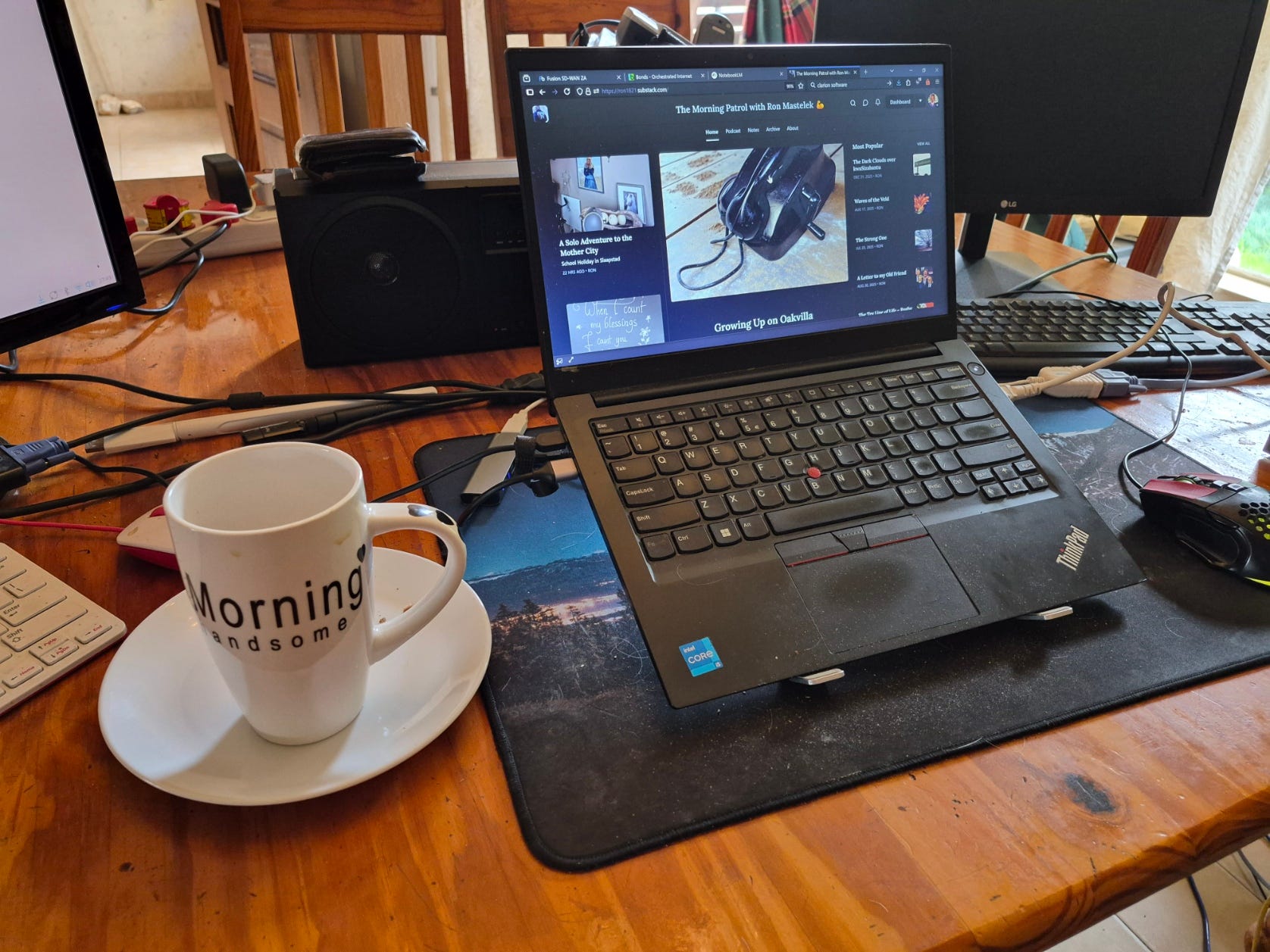
To this day, I type these reflections on a ThinkPad laptop, a reliable workhorse that echoes the durability of those early IBM PS/2s. From that humble TI calculator to modern Linux servers, each system has been a stepping stone, teaching me resilience, innovation, and the sheer joy of bending technology to human will. Computing isn’t just tools—it’s the thread weaving through my life’s adventures.