Tales of the Unbroken
Echoes of Defiance Across the Ages
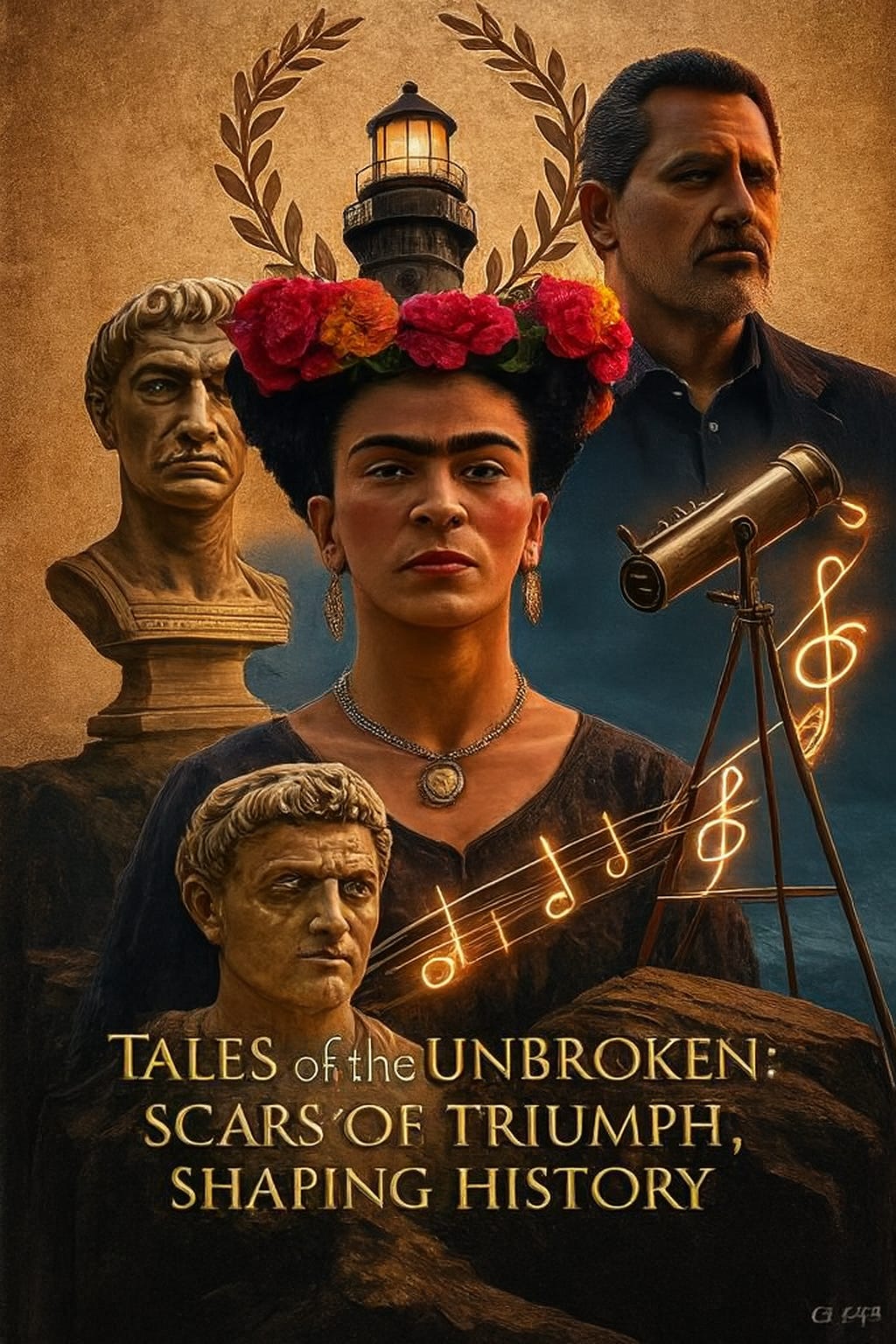
In the quiet hush of a storm-lashed evening, an old potato farmer named Mastelek sat by a flickering fire, his gnarled hands tracing the scars of a life spent wrestling the land. He was a rare man with vision in only one eye. Before him sprawled a tattered journal, its pages yellowed like ancient parchment, filled with sketches and scribbles of men and women who had stared into the abyss of their own frailties and emerged as titans. Mastelek had collected these stories over decades, not as mere facts, but as lanterns to guide himself, reminders that the human spirit, bent but never broken, forges its own path through the tempests of fate. As the wind howled outside, he began to read aloud, his voice a gravelly rumble, weaving the tales into a tapestry that spanned millennia. Each hero's journey built upon the last, a chain of resilience teaching that impairment is not a chain, but a chisel; that twists of destiny sharpen the soul; and that true greatness blooms not despite our wounds, but through them.
Echoes from the Dawn | The Blind Bards Who Shaped the Soul
The story began in the sun-baked cradle of antiquity, where the first lesson whispered: Vision lost need not dim the fire of imagination. Long before empires rose or fell, there wandered a blind poet named Homer, his staff tapping the dusty paths of ancient Greece like the heartbeat of the gods. Stricken with blindness in his youth—perhaps by the cruel hand of fate or the gods' own jest—Homer could not see the crashing waves of Troy or the wine-dark sea. Yet in the velvet darkness of his world, he conjured visions that would etch themselves into the marrow of Western literature. For nine years, he sang of heroes clashing in the Iliad, of Achilles' rage and Hector's honor, and then, in the Odyssey, of Odysseus's cunning voyage home, a tale of endurance that mirrored his own unyielding spirit. Homer's twist? He was no solitary sage but a wanderer who gathered songs from sailors and slaves, blind to prejudice, his voice a bridge between the mortal and divine. Through him, Mastelek murmured, we learn that sight is fleeting, but the eye of the mind endures, illuminating truths for generations yet unborn.
Centuries later, as the Renaissance stirred like a phoenix from Europe's ashes, another sightless seer rose to challenge the heavens themselves. Galileo Galilei, born in 1564 amid the flickering candlelight of Pisa, watched the stars through a homemade telescope until his vision faltered, impaired by relentless nights peering into infinity, eventually leaving him blind in his twilight years. The father of modern science, he mapped the moons of Jupiter and whispered that the Earth danced around the Sun, not the other way around. But his twist cut deeper: a defiant spark that ignited the fury of the Catholic Church, those guardians of “blind belief in myths.” House arrest could not silence him; from his villa in Arcetri, he dictated treatises that shattered the geocentric chains, proving that questioning dogma is the boldest sight of all. Galileo's life taught that even in darkness, the pursuit of truth blinds the oppressors, forging paths where none existed.
Flames of Creation | Artists Who Painted with Their Scars
From the forge of inquiry, the narrative flowed into the vivid strokes of artistry, where the second lesson emerged: Pain is the palette from which masterpieces are born. Claude Monet, the gentle giant of 19th-century France, began his days chasing light across lily ponds, but cataracts clouded his world, leaving him with sight in only one eye by the 1920s. The founder of Impressionism, a movement that captured fleeting moments in dappled color, painted through the haze, his water lilies blooming in furious abstraction as if to mock his failing gaze. His twist? In his final years, he underwent risky surgeries, slashing canvases in frustration, only to repaint them with renewed fury, birthing the ethereal works that would define a leading art movement. Monet's canvases remind us that when the world blurs, we must paint our own clarity, turning limitation into luminous legacy.
Across the Atlantic, in the vibrant chaos of early 20th-century Mexico, Frida Kahlo embodied this truth in flesh and fury. Polio twisted her right leg as a child, leaving her with a limp that echoed her unquenchable fire, but it was a devastating bus accident at 18 that shattered her spine, pierced her foot with iron, and confined her to months of agonizing bedrest. Yet from that crucible, she emerged as an iconic painter, her self-portraits a riot of surreal agony and Aztec defiance—eyebrows arched like thunder, flowers crowning wounds that wept. Her twist? Married to the muralist Diego Rivera in a tempestuous union of betrayal and passion, Frida channeled heartbreak into art that screamed against colonial shadows and female erasure. Through Frida, the lesson deepens: Wounds are not endings but invitations to rebirth, where the body breaks but the spirit soars, crafting beauty from the bones of suffering.
And oh, Leonardo da Vinci—the illegitimate son of a Tuscan notary and a peasant girl, born in 1452 without the silver spoon of legitimacy, yet the cornerstone of the High Renaissance. No physical scar marked him, but the twist of his birth cast him as an outsider, fueling a mind that danced across disciplines: painter of the enigmatic Mona Lisa, engineer of flying machines, thinker whose notebooks brimmed with inventions centuries ahead. His impairment? The societal scorn for bastards, which he alchemized into genius, dissecting cadavers by moonlight and sketching the Vitruvian Man as a hymn to human potential. Da Vinci whispers that origins do not define us; they ignite the polymath's flame, proving the greatest minds are forged in the margins.
Tides of Command | Warriors and Leaders Who Navigated the Storm
As the tales swelled like ocean swells, they crashed into the arenas of power and peril, unveiling the third lesson: Command is claimed not by perfection, but by unyielding will. In the salty gales of the Napoleonic Wars, Admiral Horatio Nelson stood as a one-eyed, one-armed, one-lunged colossus—his right eye blinded by a skirmish in Corsica, his arm amputated after a futile assault on Tenerife, and his lung pierced by grapeshot at Toulon. Yet he was history's greatest sailor, shattering the French fleet at Trafalgar in 1805 with maneuvers as bold as his love letters to Lady Hamilton. His twist? A flamboyant dandy who signaled “England expects every man to do his duty” while his body betrayed him, dying atop the Victory's bloodied deck, a hero's end that saved Britain from invasion. Nelson teaches that fragments of flesh cannot capsize the ship of destiny; true admirals steer by the stars within.
Echoing across centuries, Franklin Delano Roosevelt wheeled into the White House in 1933, his legs paralyzed by polio since 1921, a secret veiled by fireside chats and iron braces hidden beneath tailored suits. Unable to walk, he led America through the Great Depression's abyss and the thunder of World War II, birthing the New Deal and forging the United Nations from wartime ashes. His twist? A patrician playboy struck down in his prime, who turned isolation into empathy, quipping, “The only thing we have to fear is fear itself.” FDR's legacy illuminates that thrones are not for the able-bodied alone; vulnerability forges the strongest alliances, lifting nations when one man cannot stand.
In the smoke-choked skies of World War II, Douglas Bader defied gravity twice over—his legs severed in a 1931 flying accident, replaced by tin prosthetics that clanked like medals. Kicked out of the RAF as a cripple, he clawed back in 1939, becoming an ace with 22 kills, leading the “Legless Wonder” squadron in the Battle of Britain. His twist? Shot down over France, he evaded capture on those artificial limbs, only to be recaptured and told by Luftwaffe doctors, “We know who you are, but we don't know how you do it.” Bader's roar, that “rules are for the obedience of fools and the guidance of wise men”—teaches that wings are earned, not given; amputation of limb pales before the severing of doubt.
Harmonies of the Heart | Voices That Shattered Silence
From the roar of battle, the narrative softened into song, the fourth lesson ringing clear: The purest notes arise from silenced chords. Roy Orbison, the bespectacled cowboy of West Texas, born in 1936, veiled his vision problems behind dark sunglasses, turning nearsightedness into an aura of mystery. With a voice like velvet midnight, he crooned anthems—”Oh, Pretty Woman,” “Crying”—that tugged at the world's heartstrings, his falsetto a cry from the soul of a man who saw beauty in shadows. His twist? A gentle giant who lost his wife and two sons to tragedy, yet rose from grief's ashes with operatic ballads that made rock weep. Orbison shows that obscured sight sharpens the inner ear, composing symphonies from solitude.
In Italy's rolling hills, Andrea Bocelli, blinded at 12 by a football to the face, a cruel ricochet that stole his light, transformed loss into lyricism. The tenor whose voice soared through Time to Say Goodbye and Puccini arias became one of the most famed, filling arenas with tones that pierced the veil between worlds. His twist? A lawyer by training who traded briefs for bel canto, proving that darkness amplifies the dawn. Bocelli's aria echoes the truth: When eyes fail, the voice becomes the beacon, serenading souls across divides.
Far from operatic stages, Freddie Mercury bared his soul in Buckingham Palace's glare, his overbite—a “mouthful of teeth” from childhood buck teeth, hidden behind a Cheshire grin, yet it fueled the feral energy of Queen's performances. Born Farrokh Bulsara in Zanzibar, he delivered rock's greatest spectacles, Live Aid's “We Will Rock You,” stomping anthems that shook stadiums. His twist? A closeted queer icon in an era of shadows, whose excesses masked a vulnerability that poured into Bohemian Rhapsody's operatic chaos. Freddie's firebrand lesson: Imperfect smiles deliver the boldest roars, turning personal quirks into universal thunder.
Shadows of the Mind | Thinkers Who Rewired the World
The stories delved deeper, into labyrinths of the psyche, where the fifth lesson gleamed: Madness is the forge of genius, tempered by love's steady hand. John Nash, the Princeton prodigy whose schizophrenia wove hallucinations like theorems, birthed the game theory that underpins modern economics, from auctions to arms races. Tormented by delusions of cosmic codes, he scrawled equations on windows, yet his Nobel-winning models reshaped markets. His twist? Saved not by pills alone, but by his wife Alicia's unyielding anchor, who coaxed him back from paranoia’s edge in the 1990s. Nash's equilibrium teaches that fractured minds map the most elegant solutions, balanced by bonds that outlast storms.
Alan Turing, the shy Enigma-cracker of Bletchley Park, coded the Allies' victory in World War II, his Bombe machine devouring Nazi secrets and shortening the war by years. Father of computer science, he dreamed of thinking machines in On Computable Numbers. But his twist—a government's venomous persecution of his homosexuality—drove him to cyanide in 1954, a suicide masked as an apple's bite. Turing's tragedy underscores that innovation saves worlds, yet societies' blind hatred can unmake their saviors; his legacy endures in every algorithm, a defiant code against cruelty.
Frontiers of the Wild | Rebels and Builders Who Tamed Chaos
As twilight deepened, the tales turned to frontiers, of land, sea, and spirit, imparting the sixth lesson: Loss carves rivers through stone, irrigating empires of the heart. George Grey, the 19th-century explorer who lost his infant son to fever on a remote Australian outpost, channeled grief into founding Grey College in South Africa—one of the world's greatest boys' schools, molding leaders from the dust of Bloemfontein. His twist? A colonial governor whose empathy, born of paternal sorrow, bridged divides in a fractured land. Grey reveals that bereavement's void is a vessel for creation, nurturing legacies that outlive blood.
In the cockpits of Formula One, Jody Scheckter, the South African speed demon born in East London, raced like a bat out of hell, clinching the 1979 World Championship with Ferrari's scarlet fury. No limbs lost, but the twist of his origins—a backwater racer in apartheid's shadow—propelled him past giants. Nearby, in rugby's brutal ballet, Gysie Pienaar, Bloemfontein's son, ran the British Lions into the ground during the 1980 tour, his Springbok ferocity a testament to underdog grit. And Hollie Davidson, Scotland's trailblazing Tier 1 rugby referee, a woman whistle in a men's coliseum, commands the pitch with unerring justice, her “impairment” the glass ceiling she shatters. These sportsmen and -women roar that velocity and verdict bow to no birthplace or bias; the field levels all.
Across the waves, Eric Merrifield, the unassuming South African engineer, invented the dolos in the 1960s—a interlocking concrete beast that tamed harbors from Port Elizabeth to global coasts, saving countless lives from rogue seas. His twist? He patented it freely, dying penniless while his creation armored shores worldwide. Merrifield's quiet heroism: Invention's true wealth is in lives preserved, not pockets filled.
Sir Clive Sinclair, the bespectacled Brit whose ZX Spectrum in 1982 taught a generation to code, Mastelek among them, sparked the home computing revolution. No billionaire like Gates, his twist was the pursuit of pocket dreams over profit, from electric vehicles to synths. Sinclair shows that sparking minds outshines hoarding gold; the first “Hello World” echoes eternally.
Forges of Freedom | Prisoners and Presidents Who Never Yielded
The chronicle crested in the fires of conflict, the seventh lesson blazing: Captivity of body frees the captive mind. Winston Churchill, the bulldog of Britain, captured by Boers in 1899, escaped a Pretoria latrine with boyish bravado, penning dispatches that launched his legend. Stuttering through youth, he never surrendered to fascism, his “We shall fight on the beaches” rallying a world against Hitler. His twist? A painter-poet who quaffed champagne amid blitzes, saving democracy with wit sharper than swords. Churchill thunders that escape is an art; from prison walls to global tyranny, defiance redraws maps.
John McCain, hands mangled and broken as a Vietnam POW in the “Hanoi Hilton,” refused early release, emerging in 1973 as a senator and “maverick” who bridged aisles. His twist? A hothead tamed by torture, whose thumb's crook signed bills for POWs and reform. McCain's code: Honor's scars are badges, not burdens; gentlemen officers lead with gnarled grace.
Sailor Malan, the South African ace in the Royal Air Force, downed 27 Luftwaffe planes in WWII, then fought apartheid as a freedom fighter. His twist? A miner's son who penned the “Four Pillars of Freedom,” turning dogfights into democratic doctrine. Malan affirms that skies conquered pave paths to justice.
Sir Laurens van der Post, the silver-tongued author and Japanese POW in Java's hell, survived starvation to pen The Seed and the Sower, tales that captivated princes and peasants. Mastelek called him the best speaker he'd heard, his twist, a mystic who wove Jungian dreams into anti-colonial fire. Van der Post murmurs that words from captivity unlock souls.
In the Boer War's veldt, MT Steyn, Grey College alum and Transvaal president, outspoke his English foes in their own tongue, rallying burghers with oratory Churchill himself admired. His twist? A lawyer turned lion, whose eloquence fueled resistance till defeat's bitter end. Steyn teaches that words are weapons; the conquered tongue conquers hearts.
C.J. Langenhoven, the Cape Town scribe who battled the bottle and loved a Jewish mistress amid prejudice's gales, founded Afrikaans as a language of the people—penning “Die Stem” from tavern haze. His twist? A flawed folk-hero whose vices birthed a tongue for millions. Langenhoven's verse: Imperfect vessels pour the purest streams.
The Eternal Flame | Emperors and Enigmas
The tales culminated in imperial intrigue, the final lesson resounding: Empires fall to twists of trust, but legacies rise eternal. Julius Caesar, epileptic prince of Rome, seized the world in 49 BC, his seizures, once mocked as divine madness, channeling into conquests from Gaul to the Nile. He ruled from steaming baths, entangled in Cleopatra's asp-kissed embrace, birthing a son who would claim pharaoh's throne. His twist? Betrayed by his best mate Brutus on the Ides of March, stabbed 23 times with “Et tu?” on his lips. Caesar's fall etches that power's bath cools in blood; yet epilepsy's spark lit an empire's dawn.
As Mastelek closed the journal, the storm outside ebbed to a drizzle, the hearth's glow mirroring the unbroken chain of heroes. From Homer's blind verses to Caesar's crimson end, each had twisted fate's knife inward, emerging sharper. The lessons wove tight: Embrace your shadows, for they cast the longest light; let love and loss be your draftsmen; and remember, the impaired are not lessened—they are the architects of awe. In that lighthouse, Mastelek smiled, knowing these tales weren't history's dust, but life's living map, guiding all who dared to defy the dark.
Ronald Bartels | LinkedIn | Instagram