The Absolute Grey Gentleman
Morné du Plessis
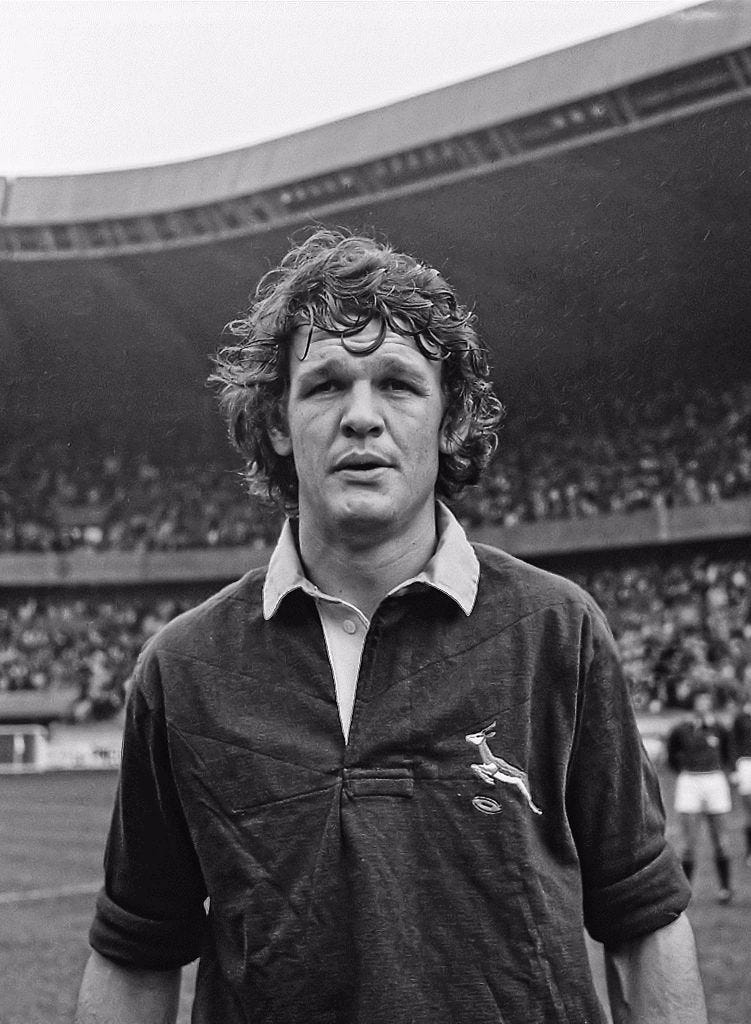
There are moments in sport when a man looks at what the game has asked of him, & quietly decides it has asked enough. For Morné du Plessis, that moment came not in a stadium, not on a tour, not under the weight of a losing score, but in the silence after a teammate died on a rugby field. He was, by any measure, one of the finest rugby players South Africa ever produced. Born in Vereeniging on 21 October 1949 into a family where sport was simply the language of life, his mother Pat captained South Africa's women's national hockey side, his uncle Horace captained the national soccer team, Morné carried bloodlines that ran deep into the soil of South African sport. His father Felix had played lock for the Springboks against the All Blacks in 1949, part of a team that swept that series 3–0. Six weeks after the last test of that series, Morné was born. The oval ball, it seemed, had been waiting for him. He came to rugby almost by accident. At Grey College in Bloemfontein he excelled more at cricket than rugby, & it was cricket that drew him to Stellenbosch University. He even played five first-class cricket matches for Western Province, taking 16 wickets at 25.62. It took Barry Richards, one of the most gifted batsmen on earth, hammering him for two sixes in a single over of a Castle Cup match, to persuade Du Plessis that perhaps another game was calling. The game that was calling was rugby, on a campus where, as Du Plessis himself once said, going to Stellenbosch to play cricket was like going to India to play rugby. Danie Craven, the great patriarch of South African rugby, who lived in the same residence at Stellenbosch, converted him from lock to eighthman, deciding the 1.95-metre Du Plessis was, remarkably, too small to be a lock. It proved an inspired move. Du Plessis captained Western Province 103 times, a record that still stands today. Here is the number that stops people cold. In 22 tests he was on the winning side 18 times. As Springbok captain, his team won thirteen matches & lost only twice. He led South Africa to a series win over the All Blacks in 1976, winning 3–1 across four tests with scorelines of 16–7, a narrow loss of 15–9, then victories of 15–10 & 15–14 in the final test. He captained the Springboks to victories over France in 1975, winning 38–25 in Bloemfontein & 33–18 in Pretoria. He led his country to a 3–1 series win over the British Lions in 1980, playing his rugby through an era of growing international isolation, in a country where sport & politics had become impossible to separate. He was nominated South Africa's Rugby Player of the Year in 1976, 1977, 1979 & 1980. And then, before the 1981 tour to New Zealand, he stopped. Mental fatigue played its part. But the deeper wound had a name & a face. In 1980, Chris Burger, Du Plessis's Western Province teammate, a full-back of twenty-eight years, sustained a neck injury during a Currie Cup match against Free State in Bloemfontein & died. He had been playing under Du Plessis's captaincy. Craven tried hard to convince Du Plessis to make himself available for the New Zealand tour, & believed, with conviction, that South Africa would have won the series if he had. Du Plessis could not go. Some things weigh more than a rugby jersey. What he built after rugby tells you everything about the man. He established the Chris Burger Fund in 1980, serving as its chairman for thirty-eight years. Now called the Chris Burger Pedro Jackson Players' Fund, it supports catastrophically injured South African rugby players & has established a twenty-four-hour emergency helpline for serious rugby injuries. He co-founded the Sports Science Institute. He was elected to the Laureus World Sports Academy & chaired the Laureus Sport for Good Foundation in South Africa, helping raise R260 million to improve the lives of disadvantaged youth. In 2007 the South African government awarded him the Order of Ikhamanga in Silver for excellence in rugby & the promotion of sport for social change. In 1999 he was inducted into the International Rugby Hall of Fame. Wellington Lions loose forward Du'Plessis Kirifi carries his name into the modern era of the game. Morné du Plessis was a cricketer who became a rugby captain, a Springbok who led through one of the most turbulent decades his country had ever known, a man who walked away at the height of his powers, not out of weakness, but out of an honesty about the cost that the game can quietly exact. He turned that honesty into thirty-eight years of work protecting the men who play it.