The Chance Meetings with the Greatest Springbok of Them All
The day television entered our lives & I discovered we had deep rooted rugby genes
My father, known far and wide as Mastelek, the strong man in Zulu, was a force of nature on our farm, but he rarely made a move without consulting my mother, Lenore. She was the quiet & beautiful anchor to his boundless energy, & their partnership was the bedrock of our family life. She was a classic Sophia Loren beauty, just like my own wife, Kathleen (Kath). But like any long marriage, theirs had its rocky patches. I never knew the full story behind one particularly tense period, perhaps it was the relentless grind of farm life, the dawn-to-dusk harvesting seasons that turned even my beloved potatoes (the best thing since sliced bread, in my book) into a symbol of exhaustion. Whatever the cause, Mom decided she needed a break & flew off to Cape Town on a Boeing 727 from Durban to visit her Aunt Marguerite for a well-deserved holiday.
We all piled into the Mercedes to fetch her from the airport upon her return. Dad, ever the character, had decided to grow a mustache in her absence, a thick, bushy one like Thomas Magnum from that TV show we’d later obsess over. To top it off, he donned an outrageous paisley shirt that screamed “look at me.” When Mom stepped off the plane & into the arrivals hall, she walked right past him without a flicker of recognition. The look on his face was priceless. By the next day, the Magnum ‘stache was history, shaved clean away, but that paisley shirt? It became a staple in his wardrobe, popping out for special occasions. I inherited his love for them; there’s something about a bold paisley that just feels right on a man with a story to tell.
Speaking of stories, I’ll never forget the day television first flickered into our lives. TV had just arrived in South Africa, & Dad couldn’t resist. He drove to Greytown and came back with a shiny Telefunken set nestled in a swanky, modern-style cabinet. His face was lit up with a moerse big smile, like he’d conquered the world. That grin vanished quicker than a summer thunderstorm when Mom laid eyes on it. She was thrilled about the TV itself, progress & all that, but the cabinet? No consultation, no dice. She had an antique fetish, just like me; I’d happily hunt antiques all day long if life allowed it. So, back it went.
The very next day, we trooped off to Greytown again, me in tow like a reluctant sidekick. I’m pretty sure the shop was Morkels, one of those old-school furniture places that smelled of polish & possibility. Mom wandered the aisles, eyeing the cabinets with that discerning gaze of hers, while Dad & I hung back, trying not to fidget. That’s when the door swung open, & in walked this giant of a man, tall, broad-shouldered, with an aura that filled the room. It was Oom Philip, none other than Philip Nel, the greatest Springbok of them all. Turns out he was family; Mom’s mother & his wife were cousins, so there were some serious rugby genes running through our bloodline. Her uncle, Windhond, had even been a junior Springbok back in the day. Oom Philip always said that Windhond should have been a full Springbok if his love for a Latin lass hadn’t diverted him to the Argentine. That family connection was via the Maritz’s. Yes, the descendants of the famous Afrikaner Trek leader whose blood ran like dust and granite through my Ouma Joey.
Dad spotted him immediately & introduced me with a proud grip on my shoulder. “Hier is my jongste seun,” he said, & Oom Philip shook my hand with a firmness that made me stand a little taller. They fell into easy conversation, Oom Philip recounting how he’d ride his horse 30 kilometers just to get to rugby games & practices in his heyday. His voice was steady, commanding yet kind, like a man who’d led armies into battle. He has done both on the sports field & in WWII. All the while, Mom was making her decision on the cabinet, an antique-looking one with ball feet & that classic, timeless elegance she adored. She was happy, Dad was happy. Happy wife, happy life, as the saying goes.
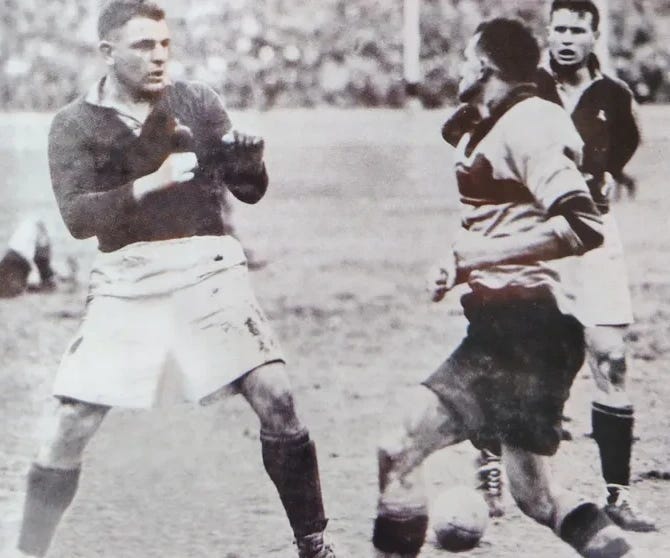
Meeting Oom Philip that day left an indelible mark on me, not just because of the family tie, but because he embodied the pinnacle of South African rugby spirit. Philip Jacobus Nel was born at the turn of the previous century on a farm in the Kranskop district of Natal, much like our own rugged patch of earth close by. Educated at Maritzburg College, he rose through the ranks as a formidable forward, playing lock or eighthman with unyielding grit. He made his Springbok debut before the depression years against the touring All Blacks, stepping onto the field at Kings Park in Durban for his first Test. Over his career, he played just short of half a century of Tests for South Africa, captaining the side in a dozen of them.
But what cemented his legacy as the greatest Springbok ever was his leadership of the 1937 tour to Australia & New Zealand. That team, affectionately dubbed “The Greatest Springboks,” achieved the impossible: they became the only Springbok side to ever win a Test series on New Zealand soil. Under Nel’s steady command, a quiet man with a voice that demanded respect, they swept the Wallabies in the warm-up matches before facing the mighty All Blacks. The series was a brutal, hard-fought affair: a narrow loss in the first Test at Wellington, followed by gritty victories in Christchurch & Auckland. With legendary players like Danie Craven & Boy Louw by his side, they outplayed, outlasted, & outthought the Kiwis, earning South Africa the status of de facto world champions in an era before official World Cups. Nel’s tactical acumen, his ability to rally his men through grueling conditions, & his sheer physical presence made him the heart of that invincible squad. He was the creator of the Springbok mantra to scrum the opposition into the ground, then go on to win the game.
As the ship carried them home from that triumphant 1937 tour, Oom Philip knew his rugby days were drawing to a close. In a poignant gesture that signaled the end of an era, he tossed his boots overboard into the vast ocean, a final farewell to the game that had defined him. It was a simple act, but one that captured the humility & finality of a true legend. Meeting him in that Greytown shop, amidst cabinets & family errands, reminded me that greatness often walks quietly among us, tied to the land & the people we love.
Some years after that serendipitous encounter in the Greytown furniture shop, I crossed paths with Oom Philip once more, this time at the Umvoti Agricultural Show, a bustling affair of farm machinery, livestock parades, & the earthy camaraderie of rural folk. By then, he was an older man, leaning on a cane for support, but his presence still commanded the space around him like the lock forward he’d been on the rugby field. Dad, ever the inventor with his “boer maak ‘n plan” mentality, had set up, showcasing his latest contraption: a tree stumper he’d built from scratch. It was a rugged machine designed to yank stubborn trees right out of the ground, clearing fields for planting with brute efficiency. Oom Philip eyed it with the keen interest of a fellow farmer, tested its heft, & bought one on the spot. Watching the transaction, I couldn’t help but feel a swell of pride in Dad’s ingenuity, Mastelek, the strong man, turning ideas into iron.
What struck me most that day wasn’t just the sale, but Oom Philip’s attire. He wasn’t sporting his Springbok jacket, the one that might have whispered of past glories on the pitch. Instead, he wore the colours of the Umvoti Mounted Rifles, his regiment from the war. It spoke volumes about where his heart truly lay in those later years, the indelible mark left by the conflict that had reshaped so many lives, including his. As they chatted, Oom Philip opened up about the bonds he’d formed with the Australians & New Zealanders during the war. He’d played against them before the guns started firing, in some of the roughest, most brutal rugby matches ever contested, down-and-dirty affairs where anything went, testing men to their limits.
But it was during the war itself that those rivalries transformed into unbreakable alliances. The Springboks, All Blacks, & Wallabies faced off again on makeshift fields across North Africa & beyond, in a series of unofficial tests that blurred the lines between sport & survival. Many of the pre-war greats, & those who’d shine after, donned their boots amid the chaos, playing for morale as much as victory. All of them, volunteers to a man, wore the red tabs on their shoulders as a badge of shared purpose. These games, held in places like near El Alamein or Beirut, weren’t just recreation; they were a way to engage the enemy in future battles, practicing the unconventional methods to win games & applying them to war. This spirit still lives on to this day & is central to the methods of Rassie, the current Springbok coach, who has more tricks up his sleeves than a magician at Boswell-Wilkie circus. They firmly cemented the relationships between our nations, turning former foes into brothers-in-arms.
Oom Philip spoke with a quiet fire about fighting the Germans hard, driven by a thirst for revenge after the fall of Tobruk early on in the war, a bitter defeat where thousands of South Africans, including comrades from his Umvoti Mounted Rifles, were captured. That loss fueled them through the grueling campaigns of North Africa & up into Italy, where he served as a Major, leading with the same steady resolve that had made him a rugby legend. That vengeance drove them all the way right up to the last vicious battles at Monte Cassino. Meeting him there at the show, cane in hand & stories flowing, reminded me that true greatness isn’t just in the tries scored or series won, it’s in the resilience of the human spirit, the plans we make, & the bonds that endure long after the battles end.