The Maritz Urn
A Precious Relic of Treks & Tea
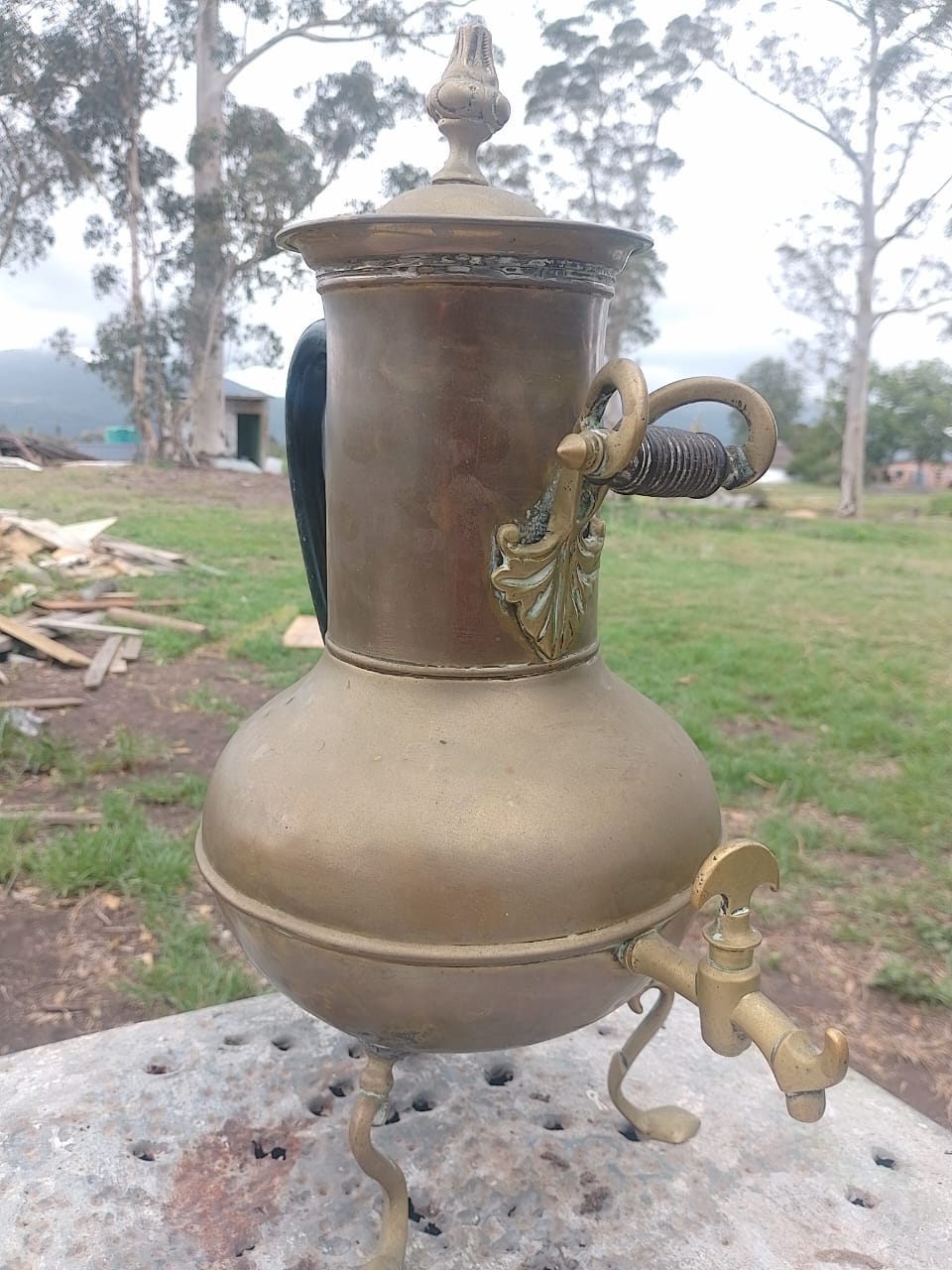
In the quiet corners of my family’s history, few objects carry as much weight or warmth, as the Maritz urn. This antique brass vessel, a water carrier designed to keep its contents hot with the gentle flicker of an oil lamp beneath, was more than a mere kitchen implement. It was a companion for brewing tea or coffee, its polished surface reflecting generations of care and conversation. My mother tended to it her entire life, rubbing it to a gleam with Brasso, as if each stroke preserved not just the metal but the stories etched into its curves.
The Maritz urn is a samovar — a traditional metal water-boiling urn, most commonly used for making tea or other beverages.
The samover has:
- Brass body with decorative elements → very typical of older samovars
- Tap/spigot near the bottom → for dispensing hot water
- Lid on top → usually where a small teapot would sit to stay warm
- Raised legs → originally designed so a heat source (charcoal or alcohol burner) could sit underneath
- Side handles (often wood or insulated) → for carrying when hot
Traditionally, samovars were used in Russia, Eastern Europe, and the Middle East. It was introduced into South Africa by the Cape Malay community and then assimilated by the Dutch farmers who would become the Boers and later the Afrikaners. Water would be kept hot in the main chamber, while strong tea concentrate sat in a small pot on top and was diluted with hot water when served.
The urn came to my mother Lenore through her mother, and before that from her grandmother, a woman married to a Bruyns but born a Maritz, a direct descendant of Gert Maritz, the Voortrekker leader whose name graces Pietermaritzburg. My Ouma Joey, full name Maria Magdalena, was christened after Gert Maritz’s wife, a nod to the resilient women who anchored these wandering families. I like to imagine the urn’s journey began in the voorkamer of the Maritz home in Graaff-Reinet, where it stood sentinel, dispensing moerkoffie, that strong, black brew that fueled late-night debates and early-morning resolves.
Graaff-Reinet in the 1830s was a hotbed of discontent among the Dutch-speaking farmers, chafing under British rule. It was there, amid the Cape Dutch gables and dusty streets, that plans for the Groot Trek were hatched. The urn would have been present, steaming away, as Gert Maritz and his kin discussed the grievances: the loss of land, perceived injustices, and the imposition of English laws that eroded their way of life. Alliances formed over cups of its hot offering, whispers of migration northward turning into firm resolves.
When the time came, Gert Maritz led his party of some 100 strong ox wagaons from Graaff-Reinet, crossing the Orange River into the vast interior. The trek was no gentle stroll; it was a grueling odyssey over rugged terrain, battling rivers, thirst, and threats from wildlife and warring tribes. The path to Natal wound through the highveld, skirting conflicts with the Ndebele under Mzilikazi, whom the trekkers eventually drove northward after battles like Mosega. Then came the formidable Drakensberg Mountains, a barrier of jagged peaks rising like a dragon’s spine. Wagons were dismantled, wheels removed, and heavy branches lashed underneath as makeshift brakes to ease the descent down the 3,500-meter slopes. Amid this chaos, the urn would have been carefully packed in a wooden kist or perhaps a reused ship’s tea box, cushioned against the jolts of ox-drawn wagons that creaked over rocks and forded streams.
Once across the Drakensberg, the trekkers entered the lush valleys of Natal, but safety was fleeting. In laagers, those defensive circles of wagons drawn tight like a fist, the urn found new purpose. By night, it simmered moerkoffie for the watchmen, keeping them alert against Zulu raids or the encroaching darkness. Alliances among the trek parties were forged and frayed here too; discussions around campfires, warmed by the urn’s glow, debated routes and leadership. Gert Maritz, elected as a key figure alongside Hendrik Potgieter, embodied order amid the uncertainty.
It was in one such tense moment that the urn bore silent witness to history’s sharper edges. As Piet Retief prepared to ride to Dingane’s kraal, seeking land grants from the Zulu king, he made a final pass by Maritz’s tent. Maritz, weakened by illness and cautious of the risks, declined to join. Retief, ever the bold one, branded him a “lafaard” (a coward) before galloping off to his doom, where he and his party were massacred at uMgungundlovu. The urn, steadfast in the laager, outlasted the man, surviving the subsequent Zulu attacks that culminated in the Battle of Blood River later that year.
Gert Maritz himself died at his laager on the Little Tugela River, never fully dwelling in the promised land he helped claim. But the urn endured, passing down the female line as a symbol of hearth and heritage. In time, modern conveniences, electric kettles and thermal flasks, relegated it to ornament status, a gleaming heirloom in our homes, evoking the tenacity of those early settlers.
For generations, it remained in the possession of women, guardians of family lore. Somehow, it fell into my hands, a man’s kitchen seemed an unlikely resting place for such a feminine legacy. It sat in my own home for years, a quiet reminder of roots. But traditions have their pull; needing a home with another woman to carry on the polishing and the stories, I shipped it off to Megs using Pudo. Its there to warm her days as it did our ancestors’, a brass thread binding us across the treks of time and distance.
The Journey to Plettenberg Bay
The Samovar has now settled into its new home with Megs, and its ancient spirit has began to weave through the air at the Craggs. Its humming a low, resonant tune, like the wind through canyon rocks back in Navajo lands, places I’d only read about but felt in my bones. But its latest journey was not all smooth sailing. It had traveled the Groot Trek once, enduring dust storms and ox-wagon ruts, only to fall victim to the modern delivery cabinets of Pudo and cardboard boxes. It snapped a leg. Just like me, when I was younger on the Rugby fields of Grey College. One of the most physically painful and traumatic episodes in my life.
That urn had it own purpose. It was its way of creating and developing a bond with Megs. I shipped down some Pratley Putty, that unassuming gray miracle born from South African ingenuity and trusted by astronauts hurtling toward the moon. The leg was restored, equilibrium achieved as the heirloom found another gatherer to continue her cosmic travels.
In Joburg, Eddy my bicycle leans against the wall, his frame silent but expectant. You see, objects like my bicycle and the Samovar now with Megs aren’t just things; they’re companions, vessels for the unseen. The Samovar’s purpose, an e
lusive glimmer of the Holy Grail, unfolding not through force or logic, but through the gentle hands of a woman attuned to its rhythm. Perhaps it was destined to heal more than metal, to be a generational defender of gatherers, to stitch together threads of heritage, from its wanderings around the southern lands of Africa, echoing the Navajo belief that everything holds a spirit, waiting to be honoured. And in that bonding, a new chapter of the Maritz Trek journey etched itself into eternity.