The Soul of a Pocket Watch
The conversation between eddy & the American Watch
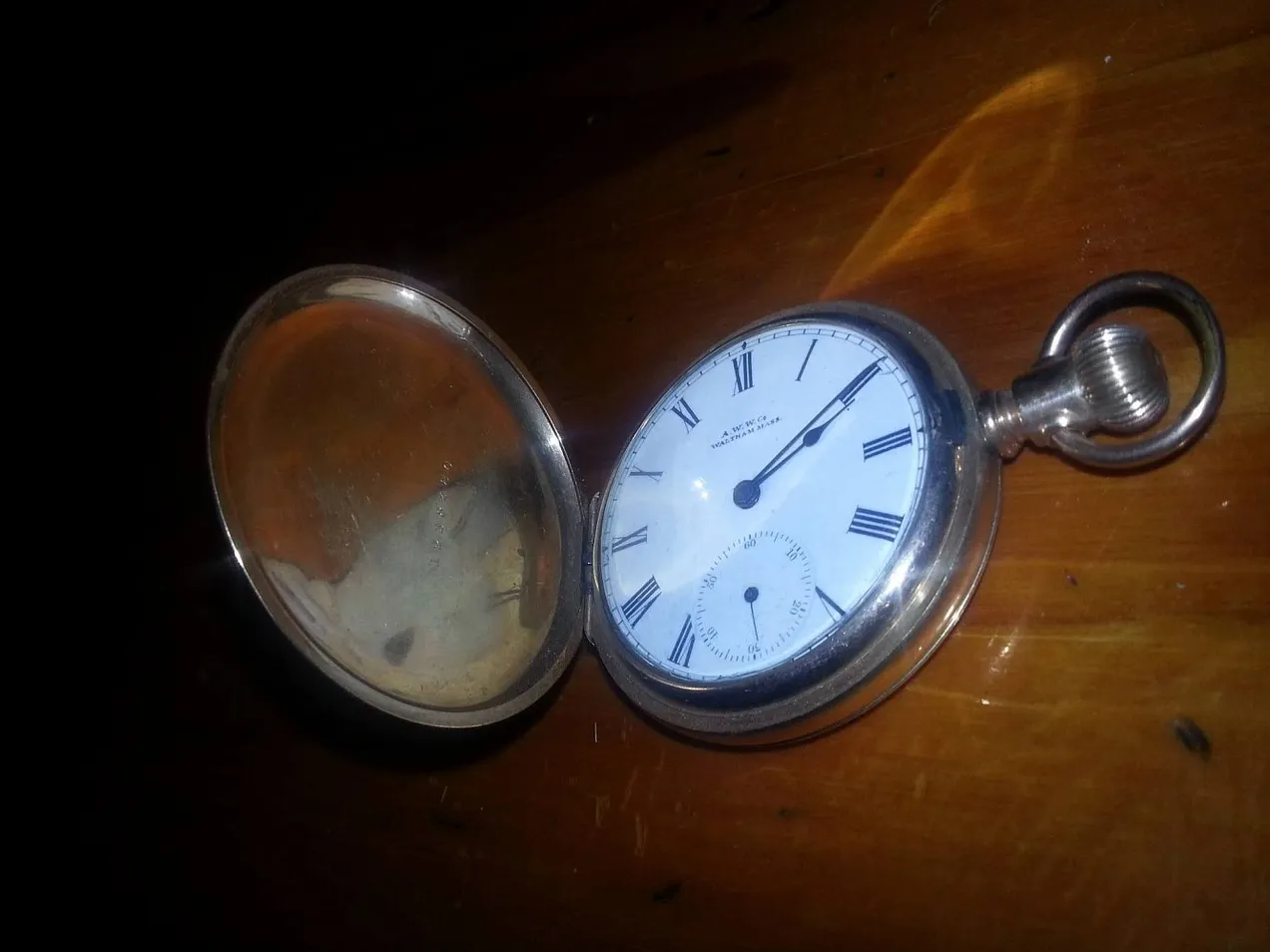 Sometimes, after a ride, eddy is left standing beside the display cabinet in the Douglasdale house.
He knows the routine. The ride is over, the dust has settled, and there is nothing particularly urgent waiting to be done. He finds himself beside the cabinet, where an old pocket watch sits quietly behind the glass.
And sometimes, they talk.
Not that anyone else would hear them.
eddy has a soul. I've have always known that. And the American Watch has one too.
It is not the sort of soul that ticks or measures the passage of time. It is something altogether different. It is the soul of a family, of a woman called Hulda, and of a life that ended in circumstances nobody should ever have had to endure.
The watch has been there through all of it.
And it has something to say.
eddy: So, tell me, Yanky. How long have you been around?
THE WATCH: Long enough, eddy. Longer than anyone who has moved through this house has been alive. I was already an old companion when the world was still getting used to the idea that time could be carried in your pocket.
eddy: You look rather ordinary to me. A bit of brass, a dial, some hands and a mechanism that keeps ticking.
THE WATCH: That's what most people see. But you know better, don't you? You have been on enough roads to understand that what something looks like and what it means are two very different things.
eddy: Fair enough. So where did you come from?
THE WATCH: Massachusetts, America. The American Watch Company, Waltham. My serial number is 1238480. You could say I was born around 1878.
eddy: That's a long time ago! I was made in 1997.
THE WATCH: Indeed. America was still finding its industrial feet. The great factories were changing the way things were made. Waltham was among the pioneers of mechanised watchmaking, producing precision movements on a scale that had previously been difficult to imagine.
I was made in a country where the railways were expanding, telegraph wires were connecting distant places, and industrialisation was changing everyday life.
Thomas Edison was developing his electric lighting systems. Alexander Graham Bell's telephone was still a novelty. The American West was being transformed by the railways, and Europe was watching its industrial revolution gather momentum.
The American Civil War had ended only thirteen years earlier. The country was still healing from it.
And on the other side of the Atlantic, Queen Victoria was on the throne. The British Empire was at the height of its influence.
Here in southern Africa, the discovery and exploitation of diamonds had already begun transforming the interior. Kimberley was becoming an extraordinary centre of activity.
The Transvaal was still an independent Boer republic, and tensions between the British Empire and the Boer republics were growing.
Within a few years, the First Anglo-Boer War would begin.
eddy: So you were already around when the Boers and the British went to war?
THE WATCH: Almost. I was made just before it. The First Anglo-Boer War took place between 1880 and 1881. The Boers fought for their independence, and the British eventually recognised the Transvaal's restored self-government, subject to British suzerainty.
I was already ticking away while the world was preparing for that conflict.
I was an American watch in a country that was becoming increasingly shaped by British imperial ambitions and Boer determination.
But I wasn't interested in politics.
I had one job.
To keep time.
The man who carried me
eddy: And how did you end up in South Africa?
THE WATCH: Through a family, as these things usually happen.
I belonged to Herman's father. I was one of his prized possessions. He had inherited me from his own father, and I was something he valued greatly.
I was not merely a device for telling the time. I represented a connection between generations.
Then something terrible happened.
Herman's father lost his cattle herd to rinderpest.
eddy: Rinderpest?
THE WATCH: A devastating cattle disease. It swept through southern Africa in the 1890s, destroying enormous numbers of cattle & devastating the livelihoods of farming families.
For a man whose wealth, security & identity were tied to his cattle, the loss was catastrophic.
He believed he was ruined. He thought he was bankrupt. He could see no way forward.
And one day, in his bed, he took his own life.
The white sheets were stained red.
I was there in the family, but I could do nothing. I could not stop him. I could not tell him that his circumstances were not the end of his story.
He had mistaken a financial disaster for the end of everything.
He had lost his herd, but he had not lost the possibility of rebuilding his life.
His son Herman would prove that.
Herman went on to make a fortune from black wattle. He established himself as a successful man and even re-established the cattle herd that his father had lost.
Think about that, eddy.
The very thing his father believed could never be recovered was recovered by his son.
The family's fortunes were rebuilt.
Life went on.
eddy: That's a terrible thing. Imagine what his father would have thought had he known what Herman would achieve.
THE WATCH: Exactly.
I have often wondered about that.
I would not presume to judge a man who was suffering so deeply. Despair can make the world appear very small. It can make tomorrow seem impossible and yesterday seem irretrievably lost.
But I know something now that he could not see then.
The story had not finished.
His son was still alive. There were still opportunities. There was still a future.
The cattle could be replaced. The money could be earned again. The farm could recover.
What he believed was the end was, in reality, a chapter in a much longer story.
I wish he could have stayed to see it.
1922: The year everything changed
eddy: And Herman? What happened to him?
THE WATCH: Herman eventually carried me in his pocket.
I was still a prized possession, an inheritance from his father. By then I had already been in the family for more than forty years.
The world had changed considerably since my manufacture.
The First World War had come and gone. Millions of men had died in the trenches. Empires had collapsed. Russia had undergone its revolution, and a new Soviet Union was taking shape.
The old European order was being dismantled.
In 1922, Mussolini became Prime Minister of Italy. Ireland was emerging as the Irish Free State, although civil war was breaking out there. Egypt had been granted a measure of independence by Britain. Howard Carter had just opened Tutankhamun's tomb, captivating the world.
And South Africa was experiencing its own upheaval.
The Rand Rebellion had erupted on the Witwatersrand. It was a violent confrontation involving white mineworkers, mining companies and the government of Jan Smuts. Aircraft and artillery were used to suppress the rebellion. Johannesburg and the surrounding mining towns experienced scenes of extraordinary violence.
It was a difficult period for the country.
But for Herman, there was another event that would change everything.
He was involved in a railway accident.
That was the fateful day.
He had me in his pocket.
I had accompanied him through ordinary days & important moments. I had travelled with him, kept time for him & remained one of his valued possessions.
Then, suddenly, his life ended on a railway track.
eddy: Did you know what had happened?
THE WATCH: No, Eddy.
I am only a watch.
I do not know the horror of an accident. I do not understand the pain of a mother losing her son or a wife losing her husband.
I cannot hear a final cry. I cannot feel grief.
I only know that the man who had carried me was no longer there.
And that the family to which I belonged had suffered another terrible loss.
There is something particularly cruel about that.
Herman had overcome the financial disaster that had destroyed his father's confidence. He had built a successful life. He had restored the cattle herd.
He had, in a sense, completed the recovery that his father never believed possible.
And then, through an accident, his own life was taken.
I was still there.
The watch survived.
The people did not.
The early sixties: Ernie
eddy: So how did you come to be here?
THE WATCH: Time passed.
I was kept in the family, away from the world, in a drawer.
By the early sixties, your rider's father, Ernie, came into the story.
My connection with Hulda was still important. Ernie was Hulda's godson, & I eventually came into his possession.
I became his family heirloom, carrying with me a history that was already several generations old.
Think about the world Ernie was living in.
The sixties were beginning.
The world was in the middle of the Cold War. The Berlin Wall would soon divide a city and become one of the most enduring symbols of a divided world. The Cuban Missile Crisis would bring humanity frighteningly close to nuclear confrontation.
The Beatles were about to change popular music. Television was becoming part of ordinary household life. The space race was gathering momentum, and men would soon be preparing to walk on the Moon.
But South Africa was experiencing a particularly dark chapter.
Sharpeville had happened in 1960. Sixty-nine people had been killed when police opened fire on demonstrators. The ANC and PAC were banned. A state of emergency was declared.
In 1961, South Africa became a republic and left the Commonwealth.
The country was changing, and not always for the better.
Ernie received me in this world of tremendous change.
Perhaps he saw an old watch. Perhaps he saw an interesting family possession.
I don't know what he thought when he held me.
But I was carrying something much older than the sixties.
I was carrying the memory of Hulda, Herman, Herman's father and all the lives that had passed through the family.
I remained with Ernie for the rest of his lifetime.
And then I waited again.
2008: Ronald
eddy: And then Ronald came along?
THE WATCH: Yes.
In 2008, Ronald was given me.
By then I was more than 130 years old.
Think about what had happened in the world by 2008.
The Berlin Wall had fallen. The Soviet Union had collapsed. The internet had transformed communication, business and everyday life.
Mobile phones were becoming indispensable. Social media was changing how people interacted. Digital photography was replacing film, and the world was becoming increasingly connected.
And in 2008, the global financial crisis was unfolding.
Banks were failing. Financial institutions were collapsing. People were losing their savings, their homes and their confidence in the future.
Once again, the world was experiencing a period when people could feel that everything they had built was suddenly at risk.
It reminded me, in a strange way, of Herman's father.
People were losing fortunes. They were frightened. They were wondering what would happen next.
But I had seen this sort of thing before.
I had seen a man lose his cattle and believe his life was over.
I had then watched his son rebuild the family fortune.
I had seen a successful man lose his life in an accident.
I had seen a family grieve and continue.
And I had seen generations come and go.
By 2008, I had become the last tangible connection to a family whose story had ended tragically on a railway track.
Ronald did not collect watches. He wasn't particularly interested in the technicalities of horology or the value of antique timepieces.
But he understood that I was something different.
I was the last memory of a family.
I was given a place in his home.
And eventually, I found myself in a display cabinet.
A message from another American
eddy: Ronald told me about a message he received from Megs. Something about letting go. What was that about?
THE WATCH: Ah, yes.
Megs sent him a message from another American.
Not an American watch this time, but an American voice carrying an idea that I have been trying to communicate for generations.
The message was about letting go.
It began with a deceptively simple thought:
“If you really want to improve your life, just let go. Allow it to be as it is.”
But the message went much deeper.
It explained that letting go is not something we necessarily have to force ourselves to do.
We tend to think of letting go as an action. We imagine ourselves holding tightly to something and having to make a conscious effort to release it.
But forcing ourselves to release something we are already holding tightly can simply create more tension.
The message offered a different way of looking at it.
Letting go can be the natural consequence of feeling safe enough to allow the world to be as it is.
It used the example of someone hanging from the edge of a cliff.
If you believe there is a thousand-foot drop beneath you, letting go is terrifying.
But if your feet are already safely on the ground, letting go becomes effortless.
The difference is not in the act of letting go.
It is in the feeling of safety.
The message suggested that the real work is developing an inner sense of safety, love and compassion, so that we no longer have to brace ourselves against every uncertainty in the world.
When that happens, letting go becomes organic.
You don't have to force it.
You can simply allow things to be.
eddy: That's a rather profound idea.
THE WATCH: It is.
And I have been thinking about Herman's father.
Imagine if he had understood that message.
He had lost his cattle. His financial position had collapsed. He believed he was bankrupt.
But what was he actually holding onto?
Was it the cattle?
Was it the money?
Was it his idea of what a successful farmer should be?
Was it his fear of what people would think?
Perhaps he had become so attached to the life he had built that he could not imagine a life without it.
He believed that losing his herd meant losing himself.
But he was still a father. He was still a man with a future. He still had a son who would go on to rebuild what had been lost.
His circumstances had changed, but his life still had possibilities.
The tragedy was that he could not see them.
I don't say this to diminish his suffering. I would never do that.
But his suicide was unnecessary in the sense that the financial disaster did not make his death inevitable. His life still had value beyond his cattle, his money and his circumstances.
Herman demonstrated that the family's fortunes could be restored.
The very future his father could not imagine became reality.
eddy: So you think he should have let go?
THE WATCH: I think he needed to find a way to feel safe enough to face what had happened.
There is a difference.
You cannot simply tell a person in despair to let go. That is not how suffering works.
But perhaps if he had been able to find some inner safety, accept that his circumstances were what they were, and allow himself to start again, the outcome might have been very different.
He did not need to solve his entire future that night.
He only needed to survive that night.
And then the next one.
Sometimes that is all life asks of us.
What the watch has learned
eddy: You've seen a lot of sadness, American.
THE WATCH: Yes, eddy.
But I have also seen something else.
Life goes on.
Not because nothing bad happens. Quite the opposite.
Terrible things happen.
People lose their fortunes. Families lose their loved ones. Accidents happen. Relationships end. Dreams disappear. The world changes in ways we never anticipated.
And yet, life continues.
The sun rises. The seasons change. Cattle graze in fields. Trees grow. Children are born. People fall in love. Someone gets on a bicycle & heads out for a ride.
There is always another morning.
I have outlived the man who owned me, the man who inherited me, the woman who connected me to this family and the man who eventually gave me to Ronald.
I have outlived the First Anglo-Boer War, the Second Anglo-Boer War, two world wars, the Great Depression, the Cold War and the arrival of the digital age.
I have watched the world move from horses and steam trains to aeroplanes, automobiles, satellites and smartphones.
And through all of that, one thing has remained remarkably consistent.
People worry about things they cannot control.
They hold onto things that have already happened.
They imagine futures that may never arrive.
They spend enormous amounts of their lives resisting the reality of the present.
And sometimes, in doing so, they forget to live.
eddy: But surely we have to care about things? We can't just let everything happen.
THE WATCH: Of course not.
Letting go does not mean becoming indifferent. It doesn't mean abandoning responsibility or giving up on the things you love.
It means understanding the difference between caring and clinging.
You can love someone without controlling them.
You can work hard without making your entire identity dependent on success.
You can remember the past without having to live there.
You can acknowledge a loss without allowing it to consume the rest of your life.
And you can enjoy what you have without constantly worrying about losing it.
Look at you, eddy.
You go out on your rides. You experience the road, the countryside, the wind and the sunshine.
You don't know what tomorrow will bring.
You don't even know whether the next ride will be as good as the last one.
But you go anyway.
You enjoy the ride while it is happening.
That is living.
The last memory
eddy: And what about Hulda?
THE WATCH: Ah, Hulda.
She is the reason I am still here in this cabinet.
I am not Herman. I am not his father. I am not Ernie or Ronald.
But I am the last physical association with a family that experienced extraordinary happiness, terrible loss and the ordinary business of carrying on.
I have no memories of the accident in the way that you or Ronald might remember something.
I cannot grieve.
But if I could be said to have a soul, it would be the soul of Hulda.
Not because I contain her, but because I have carried the connection to her through all these years.
I am a reminder that people matter, that their lives matter, and that the things they leave behind can carry meanings far beyond their original purpose.
I don't tell the story of the accident.
I don't need to.
The people who knew the horror of that day are gone.
I am simply here.
And perhaps that is enough.
eddy: You know, I sometimes think people put too much emphasis on what has happened to them.
THE WATCH: They do, eddy.
The past deserves respect, but it doesn't deserve ownership of the future.
Herman's father could not see beyond the loss of his cattle.
Herman rebuilt the herd.
Herman's life was then taken in an accident.
The family carried on.
Ernie received me in the sixties.
Ronald received me in 2008.
And here I am, in a cabinet, talking to a bicycle companion who has probably had a more interesting life than most people give him credit for.
You see the pattern?
Life is not a straight line of victories and defeats.
It is a succession of beginnings, endings, surprises and opportunities.
You cannot control all of it.
You cannot hold onto everything.
And you certainly cannot turn back the hands of a watch.
A message for Ronald
eddy: What would you tell Ronald if you could speak directly to him?
THE WATCH: I would tell him this.
Ronald, you don't need to spend your life trying to make everything right.
Some things cannot be repaired. Some losses cannot be reversed. Some questions will never have answers.
You have inherited a watch, not the responsibility for correcting the past.
You have been given a memory, not a burden.
Remember Hulda. Remember Herman. Remember the father who lost his cattle and the son who rebuilt the herd. Remember Ernie, who kept me safe for so many years.
But don't spend your life standing beside my cabinet thinking about what might have been.
Go outside.
Ride your bicycle.
Enjoy the Cradle. Enjoy the sunshine. Enjoy the people who are still here.
Write your stories. Tell people what matters to you. Make memories of your own.
And when something goes wrong, as it inevitably will, don't immediately assume that the story has ended.
You don't have to like everything that happens.
You don't have to pretend that loss doesn't hurt.
You don't have to force yourself to let go.
But try to find that place of safety and compassion within yourself from which you can allow life to unfold.
Don't confuse a difficult chapter with the end of the book.
And don't wait until you have solved every problem before you allow yourself to be happy.
You might never solve every problem.
Life is happening now.
The conversation ends
eddy stands quietly beside the cabinet.
The old American Watch sits behind the glass.
Its hands are no longer moving. It is a display piece now, an antique, a family heirloom.
But something about it seems alive.
Perhaps it is because it has survived so much.
Perhaps it is because it connects people who will never meet.
Or perhaps it is simply because we give meaning to the things that remind us of those we have loved and lost.
eddy has a soul.
The watch has one too.
And somewhere between the two of them, there is a message worth remembering.
The world will never stop changing.
People will come and go. Fortunes will be made and lost. Terrible accidents will happen. Plans will fail. The things we thought would last forever will eventually disappear.
But life goes on.
Not everything that happens needs to become a permanent part of who we are.
Not every loss needs to define the rest of our lives.
Not every uncertainty needs to be solved before we can enjoy the day.
Sometimes the greatest freedom comes from accepting that we cannot control everything.
And sometimes the best thing we can do is simply get on with living.
The watch has been here since 1878.
It has seen enough to know that the world doesn't need us to hold it together.
It will carry on quite happily without our worrying about it.
So perhaps we should do the same.
Go for the ride.
Enjoy the road.
Love the people around you.
And when you get home, put your feet up.
Tomorrow will take care of itself.
After all, the watch has been ticking for nearly 150 years. It hasn't once asked what time tomorrow will be.