The Soul That Waited in Plain Sight
The painting that was comfort & not despair
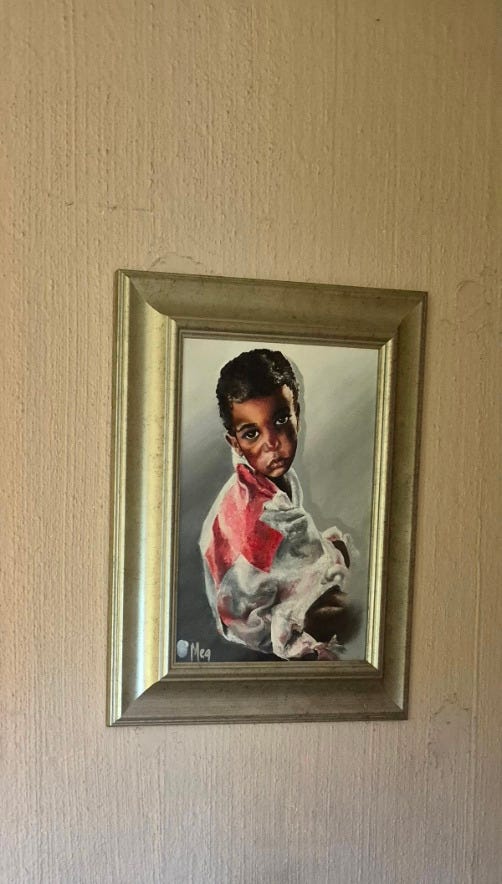
Over the weekend I searched the house for the hidden soul.
Not casually. Properly.
Cupboards were opened with intent. Drawers slid out & stayed out. I stood longer than usual in front of objects that had long ago faded into the background of my days. The antiques got special attention. They always do. Old things carry stories the way trees carry rings, quietly, without announcing themselves.
I was convinced I’d find it in something like that samovar that went to live with Meggy. That one had presence. You could feel it listening, even when it said nothing.
But this house?
Nothing.
Not a whisper. Not a shift in the air. Just the low hum of familiarity.
On top of a cupboard, one I hadn’t bothered with in years, I found an old book of coins. It had been thrown over the wall by JO when he upped sticks to the States. No ceremony, no goodbye. Just a quiet toss & into my life.
I stood there for a moment, holding it, wondering if that was how souls moved too. Not with drama, but with momentum.
Maybe there’s something in here, I thought.
I took it through to the dining room, sat down, and opened it. Page by page. Coin by coin. Maybe, I thought these coins can be made into some art!
And then…
“Does she have a blanket?”
The words didn’t arrive so much as settle. They hung in the air behind me, as if they had always been there & I had only just tuned into the right frequency.
I turned.
The cuckoo clock was silent. I hadn’t pulled up the acorn weights in days. It looked as lifeless as anything can look while still pretending to be alive.
But next to it…
There it was.
The painting I called Hunger and Despair.
It had been there for years. Meggy’s work. Her name in the bottom left corner, marked with that familiar fingerprint, her way of saying this is mine, and I was here.
I walked past it every day.
Every single day.
And I never saw it.
Not really.
I stood up & moved closer.
The painting didn’t change, but I did.
It wasn’t about hunger. It wasn’t about despair.
It was a little girl. Curled into something soft. Something protective. Something warm. A blanket, not just fabric, but a boundary between the world & whatever it was that frightened her.
It wasn’t absence.
It was comfort.
It wasn’t loss.
It was refuge.
I had been wrong all these years. Not slightly wrong, completely.
“You’re the one,” I said quietly. “The one who listened to the samovar?”
“Yes.”
The voice didn’t echo. It didn’t need to. It was steady, like it had been waiting a long time to be heard properly.
“Oh,” I said, because there wasn’t much else to say to something you’ve ignored for years. “I’ve been searching for you.”
“You walk past every day,” it said, not unkindly. “And see right through me. Never acknowledging.”
There’s a particular kind of embarrassment that comes with that sort of truth. Not sharp, just heavy.
“Sorry,” I said. “I didn’t realise.”
“It’s okay,” it replied. “You work hard.”
I let that sit for a moment.
“I thought this painting was about despair,” I said. “All this time.”
“It’s about what holds you together when things fall apart.”
I nodded.
“Everyone needs a blanket,” it added.
“That is true,” I said.
We stood there, me in the room, it in the painting, both of us somewhere in between.
Then a thought came, simple & obvious in the way good ideas often are.
“Do you want to go on a holiday?” I asked. “Visit the samovar.”
There was a pause, not hesitation, just consideration.
“Yes,” it said. “That would be perfect.”
I looked around the house. At the cupboards I had opened. At the objects I had inspected like a detective who’d forgotten what he was looking for.
The answer had been on the wall the whole time.
“I’ll go find a box,” I said.
Because some things don’t need to be uncovered.
They just need to be seen.