🚜Ugandaganda
My Love Affair with Tractors
Growing up on Oakvilla Farm in the rolling midlands of Natal, South Africa, my world was a patchwork of green fields, muddy tracks, and the ceaseless hum of farming machinery. But nothing captivated me quite like the tractors. They were the beating heart of the farm, colossal beasts of red steel that churned the earth and shaped our days. I was so entranced by them that my very first word wasn’t “mama” or “dada,” but “ugandaganda” – the Zulu term for tractor, a word that rolls off the tongue like the rumble of an engine, full of power and poetry. To this day, it’s my favorite word, evoking the raw, mechanical magic that defined my childhood. My dad and mother were very proud of my first word, and readily informed all and sundry about it.
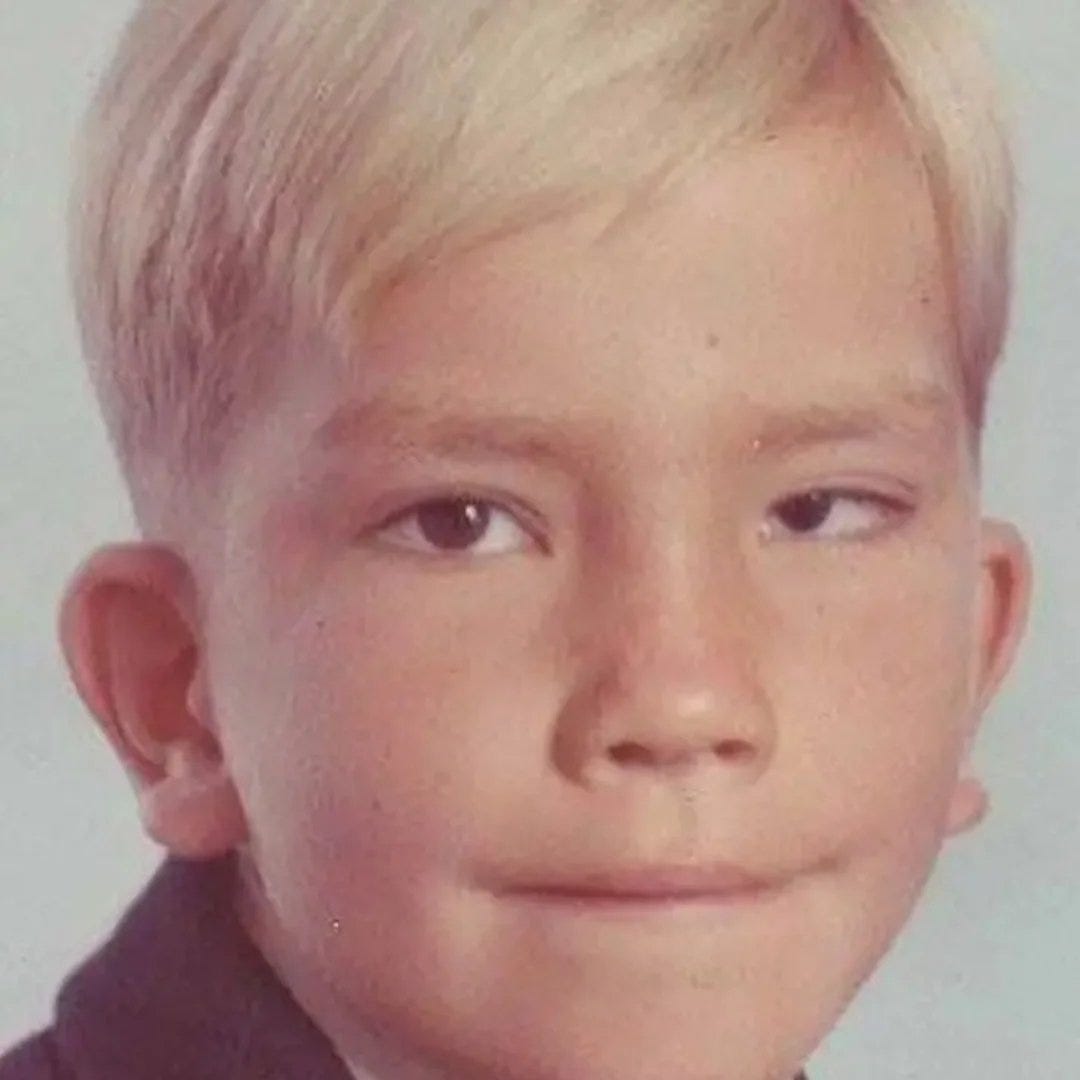
Back then, I was blissfully unaware that my given name was Ronald. Everyone, from my parents to the Zulu workers who shared our land, called me Beebee. It stuck like mud on a tire tread, a nickname that followed me through the dusty tracks and endless rows of crops. My fascination started early, as a plump toddler barely able to waddle. My parents, sensing my obsession, gifted me a shiny plastic red ride-on tractor with push pedals. I’d zoom around the yard for hours, imagining myself plowing vast fields, the wind in my blonde hair and the world at my command. Yes, I was blonde and my hair darken as a teenager.
As soon as I could toddle close enough, I’d beg to sit on my dad’s lap atop one of our real tractors. Those were glorious moments: the vibration of the engine thrumming through my tiny body, the scent of diesel mingling with fresh-turned soil. Before long, I’d grab the steering wheel with chubby hands, guiding us along the furrows. When I grew a bit taller – though still too short to reach the pedals, I’d hop off the seat and stomp on the brake or clutch with both feet, my laughter echoing over the fields. Holidays were the best; while other kids played games, I’d volunteer to plough, letting the Zulu tractor driver nap under a shady tree as I took the wheel.
Our farm was a symphony of cultivation, with potatoes as the star, a vegetable I now hold in almost religious awe, their humble tubers yielding endless bounty. We’d rotate in cabbage, cauliflower, Brussels sprouts, and madumbis, those creamy tubers that make the quintessential curry, rich and comforting like a warm embrace. To work the land, we relied on an arsenal of attachments: a tiller for breaking soil, a rotor for finer prep, and a massive multiple-row plough with circular ploughshares that sliced through the earth like a knife through butter.
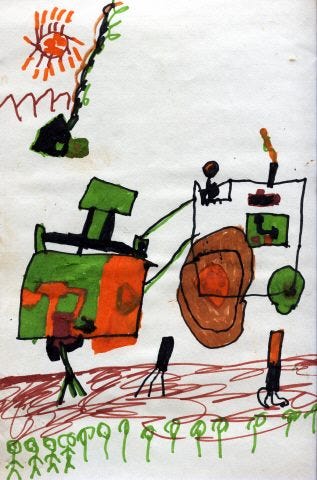
At the core of it all were our red Massey Ferguson tractors, the unyielding workhorses that powered everything. My dad, ever the innovator, even designed a custom attachment he dubbed the “Stelek Stumper”, a beastly contraption that uprooted tree stumps with ruthless efficiency, clearing fields for new planting in record time. (See my drawing as a kid of the tractor and stumper) We had a grader attachment too, essential for maintaining the valley roads after the relentless Natal rains turned them into quagmires. To top them off, we’d haul loads of gray shale using a converted Ford truck with a dumper body, which I’d help load using our yellow Massey Ferguson TLB (tractor-loader-backhoe). That TLB was a marvel, a Swiss Army knife on wheels.
My brother, my boet, & I once put it to mischievous use, building a makeshift dam across a stream that fed into the Inyosi River. We piled up earth and rocks, dreaming of our own private pond. But when it filled, the water overflowed and diverted the stream straight down the farm road, flooding everything in sight. That led to a frantic after-hours session in the dark, my dad using floodlights and the very same TLB to dismantle our creation, grumbling all the while but with a twinkle in his eye.
Not all our tractors were heroes, though. We had one blue Ford that was perpetually on the fritz, coughing & sputtering until it was finally abandoned to rust in a forgotten corner of the farmyard, a relic of mechanical defeat.
Beyond the fields, tractors wove into the fabric of our community life. On payday, we’d hitch a trailer to one and rumble into New Hanover dorp, ferrying the Zulu workers to the White House shop. Run by an Indian dealer, it was a wonderland crammed with everything imaginable: hardware tools on one shelf, fresh produce on another, clothes dangling from hooks, and even goods suspended from the ceiling on wires. It doubled as a greengrocer, supermarket, and candy emporium, that sweet counter was pure fascination, jars brimming with colorful temptations. Shops like that are lost to history now, replaced by sterile chains, but in my memory, it’s a chaotic paradise.
I’d also lend a hand hauling 20kg bags of mieliemeal from our storeroom to the workers’ quarters, balancing them precariously on the tractor’s rear attachment struts. Simple tasks, but they made me feel part of something bigger, the rhythm of farm life pulsing through every jolt and turn.
Even now, decades later, I crave the feel of a rusty tractor seat beneath me, each bump jarring my spine not as pain, but as a monk’s austere meditation – a reminder of hardship’s quiet grace. And the diesel exhaust roaring through the stacks? That’s no mere noise; it’s a symphony, pure and unfiltered, the soundtrack to a life forever tethered to those magnificent machines. Ugandaganda – the word, the wonder, the enduring fascination that started on Oakvilla and never let go.