Cosmos, Blackjacks & Kharkibos
I went to Grey!
The Golden Liberals
The term liberal means the assimilation of cultural attributes into a greater systematic governance. Two examples exist. Winston Churchill and George Grey. Churchill assimilated the Boers and the Commonwealth. Grey assimilated the Maoris. An example in America would be Lincoln who assimilated the Southerners. The binary nature of politics today where people are divided into left and right wing has resulted in the term liberal being misunderstood as liberal does not mean left wing. These is no way that either Churchill or Grey could be classified as left wing. They also were balanced and stood up to blatant dictatorship. A true liberal is gold and probably has some Scottish heritage. My ancestor, Christoph Bartels had a similar relationship with the Zulu’s while on my maternal side the Elliots and the Murrays, who were indeed Scottish, became boers.
In 1980 I started my association with the Golden Liberals as my parents enrolled me at Grey College. That year there was a one hit wonder, Video Killed the radio star!
George Grey
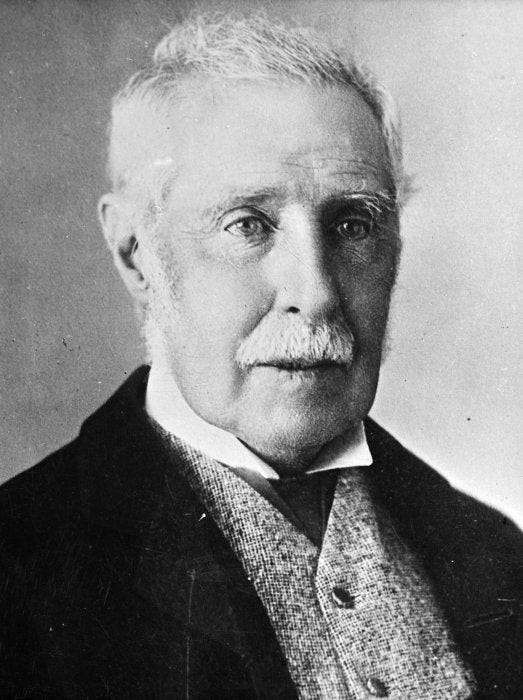
That day shortly after Easter as the second decade of the 19th century was starting was not the day George Grey was meant to enter the world. His mother went into premature labour in Lisbon, Portugal after inadvertently overhearing a conversation in which it was mentioned that her husband had died. George Grey's father had died in some insignificant skirmish. Tragedy did dog George Grey. Although he became a distinguished diplomat, he lost his own son early on in his marriage. He was estranged from his wife for the most part of his life, but notwithstanding, George Grey’s influence stretched over both New Zealand and South Africa. He was the founder of the school I attended, namely Grey College in Bloemfontein.
Grey was Governor General of the Cape Colony in the mid-19th century. South Africa did not exist in those days. The Cape Colony, the present-day Western Cape, was a British Territory. Just more than a decade before, the Boer population had started migrating north. Boer republics were established in the Free State, Transvaal, and Natal. My family was part of the grouping that ended up in current day Pietermaritzburg.
The reason for this migration is often stated that it was triggered by the abolition of slavery. However, this is a simplification of a problem where there were multiple causes including the pressure for greater farming resources.
Unlike, a similar trek that occurred in Northern America, the Boers did not decimate the indigenous population with modern weapons. In Northern America, the local indigenous tribes were exposed to genocide. An irony never lost on me whenever the first world wags its finger in self-righteousness. I am not a first world resident, confined to what a leader of the free world referred to as a shithole.
The British rapidly annexed the Boer colony of Natal and during the period following this event there was the infamous self-inflicted starvation of the Xhosa. George Grey was Governor during this time and resolved the situation by assimilating Xhosa officials into government structures. Having dealt with the Xhosa crisis he focused his attention further north.
Grey visited the Boer republics and was well received. He wanted to unite the British colonies and Boer republics and ironically the Boers were not averse to the suggestion. However, the British Foreign Office was!
George Grey's journey to the inland region of Southern Africa was vastly different in those days was vastly different than it is today. There were no roads and very few settlements. The social event that was most attended was the monthly church gathering known as Nagmaal, the Christian rite communion. The mode of transport was horses as well as the ox wagon. These ox wagons would be the primary source of transportation inland into South Africa before railways started to be laid out in greater lengths in the latter part of the 19th century.

Invaders
In those days there would have been no Cosmos flowers next to the side of the road or path. There would also have been no Blackjacks to catch on your socks or trousers when a person went to answer the call of nature in the veld (since there were no garages with toilets). Neither would there have been any Kharkibos dotted around the veld.
All these invader plants came to Southern Africa during the Anglo-Boer war, after George Grey's death. The war resulted when the colonies and republics became belligerent after the discovery of diamonds and gold at Kimberly and Johannesburg, respectively. When the war erupted, the British shipped in many troops and horses. The horses were provided with feed from Argentina and contained the seeds of Cosmos, Blackjacks and Kharkibos. This was the country to which Windhond, one of my family would eventually settle in.
George Grey's efforts to avoid this future conflict in the mid nineteenth century had not met with approval from his bosses in London. They decided to recall him. Sounds very much like present day cadre deployment and shenanigans by the ANC! On the ship back to Britain, he became estranged from his wife. Arriving back in London, a new government had been voted in and George Grey had new bosses. His new masters were not averse to his views and wanted him back at his old post. Fate, however, intervened. In New Zealand, the Maori wars broke out and George Grey was diverted to resolve the issues in that country. His influence on the course of South African history was stopped and instead his greatest legacy would be made in New Zealand.
It is highly unlikely that should George Grey have remained in South Africa that the conflict with the Boers would have escalated into a war. More importantly he would not have allowed the foundations of Apartheid to be laid. It is also unlikely he would have disenfranchised the indigenous population. It was also Grey who made a significant intervention to ensure that peace was made between the Boers and Basuto and that what is how Lesotho was established.
Grey resolved the conflict between the two belligerent parties by defining a mutually agreed border. Being a fit man, he walked the border with the parties including climbing out some steep koppies. Some of the Boers leaders were as portly as their contemporary counterparts and struggled to keep up. Soon afterwards the treaty was signed.
Kiwi
In South Africa George Grey had learnt his lessons well in how to deal with the British Foreign Office, and as a result made many unilateral decisions in New Zealand. More famously he created a new constitution without input from London. New Zealand did not turn out bad. It is one of planet Earth’s most progressive nation with a young woman as its leader. I often wish to be a Kiwi as the New Zealanders name themselves.
On a recent trip to London I walked through St. Paul's churchyard on the way to the London offices of the bank I was working for at the time. The crypt doors had just opened, and I popped in to have a look. There was the grave of Nelson, one of the most famous of British warriors, and next to him was interned Sir George Grey. It was an insightful moment for me to realize how prominent a member of Victorian Society he was that he was honoured with a position at the side of Nelson. In another twist of fate, South Africa would also have its own famous Nelson in Mandela.
Since his birth two hundred years ago George Grey left a great impact and legacy with his actions. One of those happened on that trip previously mentioned into the interior of South Africa, when he stopped at Bloemfontein.
At Bloemfontein, he was met by an honour guard of horsemen which included Andrew Murray. Murray was one of the same descendants of my family of the Scottish Calvinists who came to this country a century before. During his stay at the settlement, Grey bequeathed a couple of thousand pounds for the establishment of a school for boys. This was in memory of his son who had died in infancy. That school became the world-famous Grey College, noted as a Rugby factory. One of the first leaders and teachers at the school was Andrew Murray. He became a well versed and revered theologian and effected formulated the basis of the Christian movement in South Africa. Elsewhere in South Africa, Christof Bartels was using his ministry to dull the trauma of his years in the cavalry. From the school's inception, the boys who would call Grey College their Alma mater would make their mark on South African and world history.
During the Anglo-Boer war the real leader was President Steyn, a Grey boy, and not Kruger. Churchill referred to him as the only real Englishman at the treaty talks, in a disparaging reference to the members of the unrefined British delegation. Steyn was a member of Temple Bar, and his adversaries were not close, neither in language, nor ability.
In the same war, a Grey boy, Deneys Reitz, would be a bittereinde, someone who would fight to the last. When peace was eventually made, he established one of the most prominent law firms in the new Union of South Africa. His book, Commando, would become one of the defacto standard stories about war. During the First World War, Reitz would serve as a Guard Colonel in the British Armed Forces. In the Second World War, he would be South African High Commissioner in London.
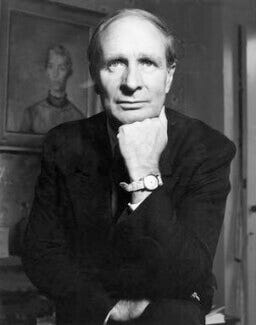
During the two World Wars there would be a couple of great men who graduated from Grey College and would make an impact on the global stage. The first was Sir Lourens van der Post. He was a novelist, philosopher and World War Two soldier. The other was Braam Fischer. Braam Fischer was Nelson Mandela's lawyer and friend. He would pay a heavy and torturous price for his opinions and actions. However, without the efforts of Braam Fischer the course of South African history might well have been very different. Mandela referred to him as the Afrikaner who changed his opinion and planted the seed in his mind that reconciliation was possible. Fischer used to live down the road from me in another suburb of Johannesburg known as Greenside.
During the Second World War, the headmaster's son gave his life to the cause of attempting to assist in the Polish Ghetto uprisings. The Polish uprising is notorious as the Russians knowingly did not intervene to stop the Germans suppressing the uprising. This would allow Stalin to better control a weakened post war Poland. The Headmaster's son was a pilot who was flying in supplies for the uprising, and whose effort with many other South African airmen would be unacknowledged post war due to political machinations.
Greybrakke
The political allies of Sir George Grey were known as Greyhounds or Windhonde in Afrikaans. Amongst the boys of Grey, we call ourselves the Greybrakke, which is a derivative of the Afrikaans word for hound or dog, but more specifically mongrel. That was the same nick name of Riebeeck Elliott. The character of these individuals has its roots in an act made on horseback in the flat and never-ending veld of the Free State by a liberal gentleman, who was ahead of his time.
Donuts & a coke
My dad would take me to Grey College in either our Mercedes Benz 300D or Nissan 1400 bakkie from the Natal Midlands to Bloemfontein. It was a five-hour journey stretching over parts of the roads that were always under repair. The roadside would be dotted with Cosmos, Blackjacks and Kharkibos. At Grey I was focused on academics as my sporting abilities were non-existent. That did not stop me from participating, even reaching the second team in my age group on occasion. The school had several old and historic buildings, many built by the famous South African architect, Herbert Baker. But the building that was the most comfortable was the one known as the Tuckshop. Nestled amongst the firs in a corner of the school, the building dated from the Anglo Boer war where it served as a temporary hospital. It was a wooden structure that had been covered in corrugated iron sheets. After school we would spend our meager pocket money on cokes and donuts and occasionally hot dogs. A school term was 10 weeks, and my mom would often post me letters with extra R10 notes in the envelop which when opened would necessitate a trip to the Tuckshop. In those days, the post office worked like a well-oiled machine. By the turn of the millennium, it became a joke as post and parcels would be subject to pilfering.
The Daly of academics
The clever boys in my standard were Jan von Delft and Japie Thiart who would always be in the first and second position in the academic standings. Except, one time, were I sparked and shocked everyone to stand at the top of the standard. It was like John Daly winning his first golfing PGA Championship going from zero to hero.
I was in the hostel where we were a bunch of rabble rousers. Because of my academic ability the headmaster, Michau Heyns would cut me slack, often punishing my mates while I walked off scot free. He would look and me and ask me why I would admit to some ludicrous escapade that my mates and me had participated in. I would attempt to prove my rebel credentials to him, and he would send me on my way without punishment. He was a mathematics teacher and I enjoyed mathematics. I was in his eyes a mathematician and not a rabble rouser.
Klaas
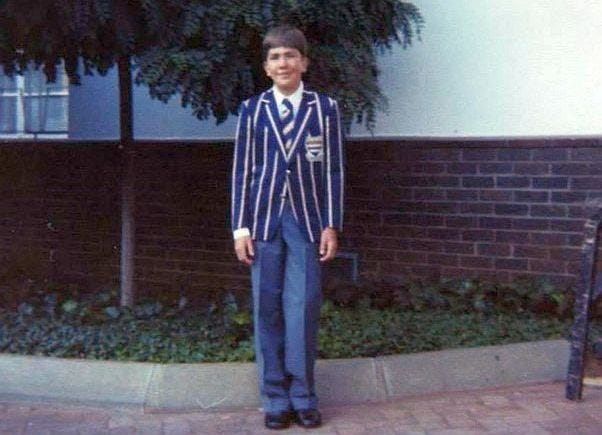
We had several traditions at Grey. We wore a blazer that was a fashion insult and greet each other with a handshake taken from an obscure French knife brand that some old pupils brought back from Europe after the First World War. The knife was a Opinel and that handshake is commonly known as that of John the Baptist. However, some things were universal. My friend at school was Eion du Toit who was ‘n verligte. We would know him as Klaas. The first day in the hostel when the prefects asked us where we came from, we gave out hometown names. Eion arrived a bit late and when the prefect asked him where he was from, he replied that get came from the plaas. The prefect promptly named him Klaas van die plaas on the spot, and that name would stick with him for the rest of his life.
We had many conversations and would meet often. One memorable year we drove to a Grey reunion meeting in Bloemfontein. Klaas was an expert in craic. At the reunion dinner we were a few minutes late as Klaas had brought along a bottle of Johnnie Walker Platinum Scotch whisky which we shared in the parking lot with a dozen other old Greys. Klaas would die from a sleep apnoea disorder. He was visiting Johannesburg and we had one last dinner and drink at the Parkview Golf course before I dropped him off at his bed and breakfast. He did not make it to morning.
Hansie
Often, we would go down to Grey around Founder’s Day in October. The one year I bumped into the headmaster who came after Heyns and whom we called Vollies. Now Vollies could talk the hind leg off a donkey and not give you any opening to butt in with your own conversation. He always reminds me of the day he found me in a plaster cast straddling the swimming pool gate. I had broken my leg in a rugby game but on that day decided to join my mates at the pool on my crutches. When my mates saw Vollies coming they scattered, leaving me in the position that Vollies found me. He was highly amused and wanted to know if I was planning to swim while I was in the cast. He helped me down and walked with me back to the hostel. By this time, my mates had remorse and had lined up at his office for the obligatory hiding. For once, he let us get off scot free.
Vollies invited me and Klaas to lunch in the Cricket pavilion. The past versus present game was being played that day. I was randomly placed next to Ewie Cronje who was the father of Hansie Cronje. Hansie had been implicated in a cricket fixing scandal that had ended his career. He had been banned Cricket and tragically died in an aircraft accident near George. Kathleen (Kath) & I had driven down to Grey for the funeral and were seated next to another famous Bloemfontein sports personally, named Zola Budd. Budd had participated in the Olympics and had a notorious race against Mary Decker who crashed into her. You know the rule, the one ramming you in the rear end is always to blame. As a South African aside, all Toyota taxis are known as Zola Budds and the Nissans as Mary Deckers. The Zola Budds are more reputably more reliable.
I decided to make conversation with oom Ewie and asked him how his day had been watching the Cricket. He turned to me and said that when you are young you go home to your family as that is the best place to be. When you are older, he continued, you go to your school because that is where a person then finds comfort. Tears started rolling down his face and we ate lunch for a few minutes in silence before the conversation picked up again. I realized that at the school were the fondest memories of his son and during this time is son would usually be visiting him. He remembers his son, not at Lord’s or any famous cricketing ground but a lonelier grassy patch in Bloemfontein with less spectators. Even though the tears were rolling down his face, there was no better place in the world he would rather be.
I have encountered many interesting characters associated with Grey. This included Hayward Kidson, one of South Africa's leading all time cricket umpires. I met him at a lunch at the Rosebank Hotel. He told me his greatest moment in the game was telling Bill Lawrie to f##k off when he was obviously out but he remained standing at the crease. Bill Lawrie he told me, won't even walk to catch a bus.
It would be well over fifty years after Grey’s trip on horseback before the first cars would make their smoky way to the settlement of Bloemfontein. And it would be one hundred and fifty years before George Grey's view of democracy would eventually become a reality in South Africa. The present-day history in South Africa would have been vastly different if Grey had come back to South Africa instead of going to New Zealand. It is highly likely that apartheid would never have been created with its policies of systematic racism. I am liberal and I was a Greybrak and I was born a South African.
1984
My Matric class was 1984 and we still maintain and keep contact. We always joke about how you know when someone went to Grey. The answer is they tell you.
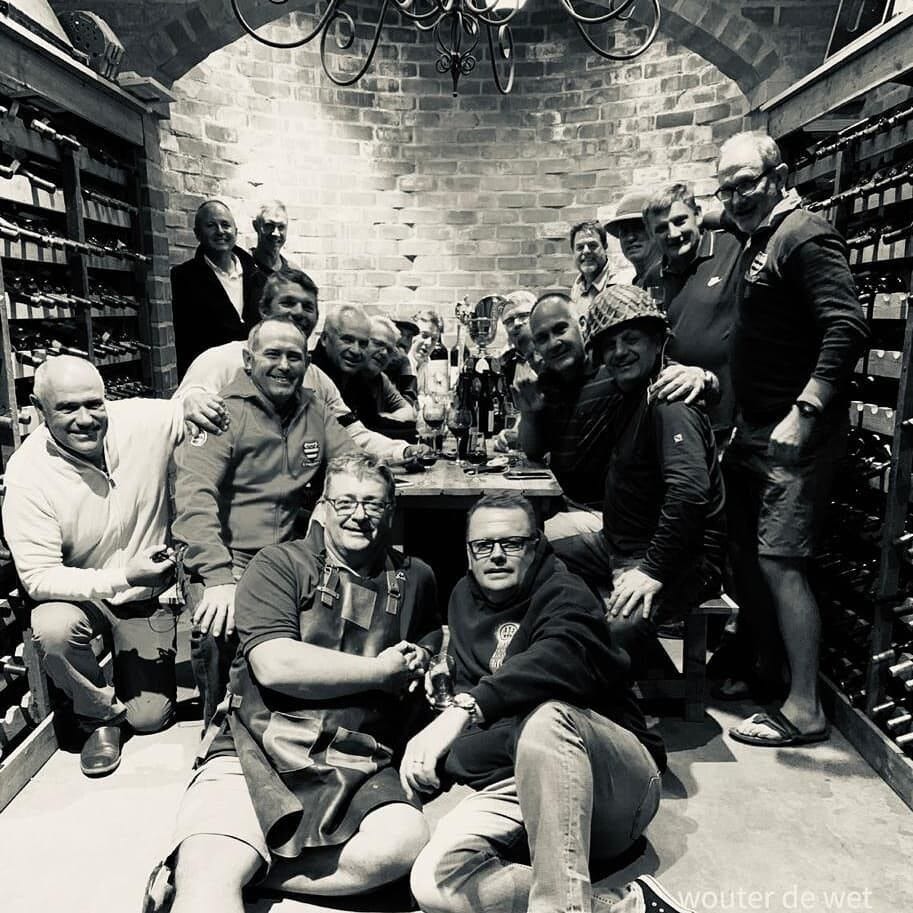
That year in 84 was one of the best in music, with Queen being the best.

Leith House | A Lesson in Lines and Loyalty
In Standard 8, I moved to Leith House, the third hostel at Grey College, as a “New Poep.” The initiation was brutal, akin to army basic training, grueling, relentless, and designed to toughen us up. It did. I shared a room with Gordon on the cold side of the hostel, where the winter chill seeped into our bones.
One winter weekend, after a rugby match, I returned to the hostel, still buzzing from the game. A matric named Visser was there, lounging with the arrogance of seniority. He made a derogatory remark about my eye, I had a coloboma. The words hit like a spark to dry grass. I saw red. Without thinking, I swung, my fist connecting with his face. Only after the punch landed did I realize the folly of my action. Visser was older, bigger, stronger, a matric towering over a Standard 8 kid. But some insults cross a line, and this was one of them.
His reaction unfolded in slow motion. I braced for the counterpunch, watching his fist arc toward me. I ducked, and it sailed over my head, but his jacket wasn’t so lucky, the seam split with a loud rip. I thought I was done for, ready to face the inevitable follow-up blows. But then, standing beside him was Andries Kriek, a prefect. He stepped in, placing a firm hand on Visser’s arm. “Stop,” he said, his voice calm but ironclad. “You asked for it with that insult.” He warned Visser that if he hit me, he’d have to deal with him.
For the rest of the year, I showed my gratitude by helping Kriek with chores. One day, while tidying his room, I stumbled across his stash of Penthouse and Playboy magazines hidden in his cupboard. In those days, such magazines were banned, their presence a rebellious secret. My eyes were opened, not just to the contraband, but to the unspoken codes of Grey.
Leith House had a self-regulating system, a balance between cheekiness and cruelty. There was a line, and everyone knew it. Visser crossed it, and Kriek, a true man of Grey, enforced it. His intervention wasn’t just about stopping a fight—it was about justice, about recognizing when a line had been breached and setting it right.
The Wit Olifant Caper
One eventful day, I was recruited by Kriek to carry paint cans. He and his fellow matrics were off to paint a rival school, Sentral’s, mascot, a concrete elephant known as die Wit Olifant, painted white, naturally. There I was, squeezed into a seat with a bunch of hefty rugby players in the back of a Ford Valiant, a beast of a car. We stopped at a suburb house belonging to one of the boys to raid his dad’s paint store. The matrics sat in the car, smoking, while I lugged the paint tins and loaded them into the boot.
We arrived at Sentral, ready to transform the Wit Olifant. Unluckily, I hadn’t packed paintbrushes—no one had given me that instruction. Without missing a beat, the matrics poured the cans over the concrete elephant. By the end, it looked like a psychedelic, mythical creature ready to take flight. Everyone was pleased. But that wasn’t the end.
The following Monday, Heyns climbed onto the tannoy and summoned the belligerents who painted the elephant to the office. I was in Afrikaans class with Trevors as the teacher. When I tried to leave, he didn’t believe me and told me to sit down. My conscience gnawed at me, so I approached him again, insisting I needed to go to the office. He agreed, but only after laughing so hard tears streamed down his face.
At the office, the matrics were lined up at the desk in front of Heyns. “What are you doing here?” he asked me. “I carried the paint cans,” I said proudly. He looked at me, noted I was good at maths, and let me go. Then, turning to the matrics, he flexed his cane with a loud swish, telling them they weren’t good at maths and to get ready to bend.
When I returned to class, Trevors had another fit of laughter when I told him Heyns had chased me away.
The Matric Serenade
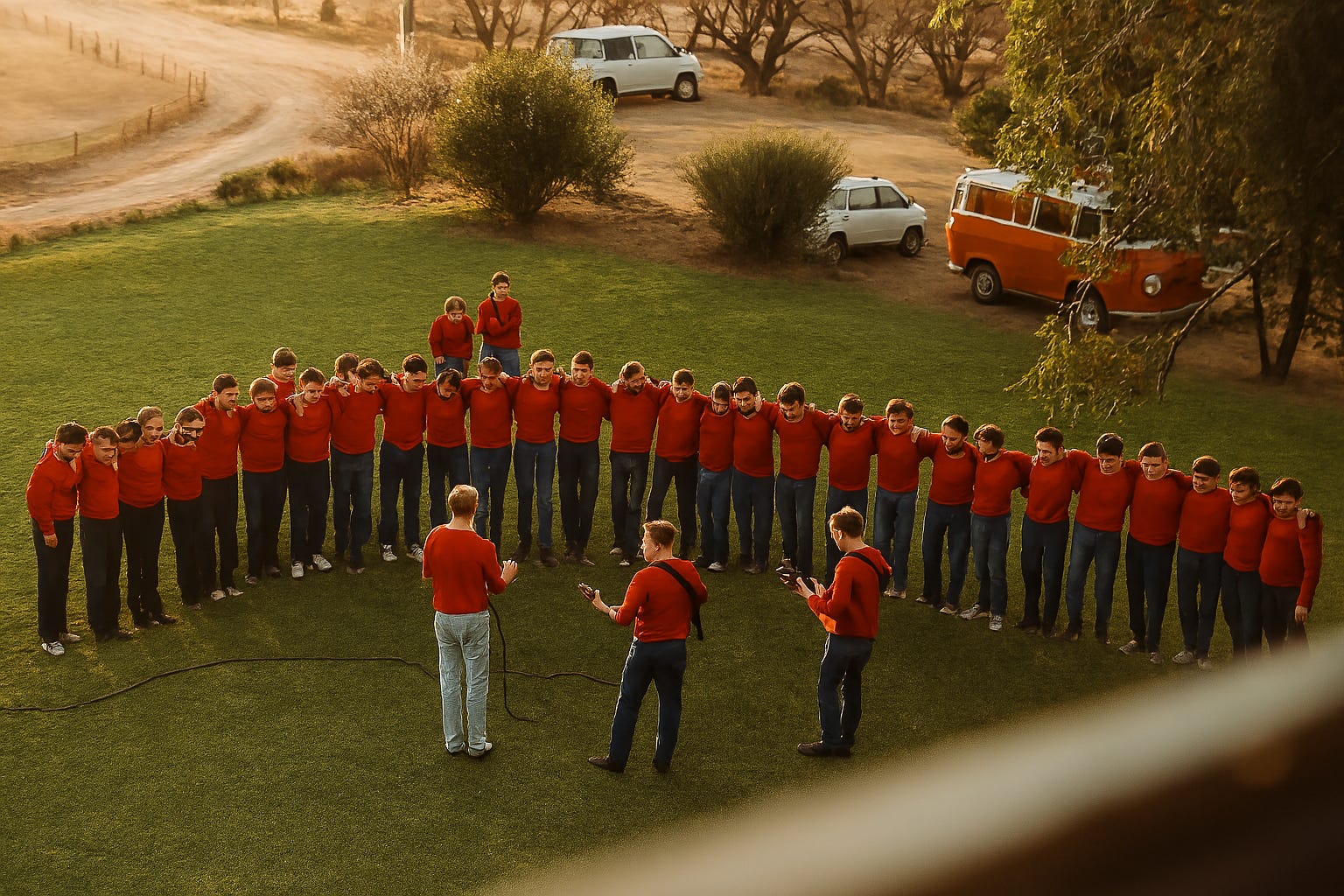
The air in the Leith House Appel kamer buzzed with a nervous energy, the kind that only comes when you're young, reckless, and standing on the cusp of something unforgettable. The room smelled faintly of chalk dust and polished wood, with that out-of-tune upright piano squatting in the corner like an old friend who’d seen better days. Above it, the blackboard was a chaotic canvas of song lyrics scrawled in white chalk, our hymn sheet for the night. Printers weren’t a thing back then, so Bester and Marx, our resident piano maestros, pounded out the melodies on those worn ivory keys, coaxing notes to life despite the piano’s protests.
Chita and Grobbies, the guitar heroes of our crew, were the real showmen. Chita, named for his obsession with Tarzan films, swinging through our imaginations like a jungle king, had been taking lessons with Tommy Cronje, our long-haired geography teacher who moonlighted in a band and carried the kind of cool we all envied. They strummed their guitars with a confidence that made us believe we could pull this off. The songs? A trio of heart-on-sleeve classics: Air Supply’s Making Love Out of Nothing at All, Nelson’s To All the Girls I’ve Loved Before, and Peter Cetera’s It’s Hard to Say I’m Sorry. There was a fourth, but it’s slipped into the mists of time, lost like so many fleeting moments from those years.
The night of the final year’s Ball was the main event. We piled onto the old Mercedes school bus, its engine rumbling like it knew the weight of our mission. One of our mates, barely legal with his grade 10 license, took the wheel, our very own teenage chauffeur steering us through the night. We toured the girls’ school hostels, stopping beneath their balconies like Romeos in scuffed school shoes, serenading them like Juliet’s with all the passion our adolescent hearts could muster. The girls leaned out, their laughter and whispers floating down, and for those hours, we were legends. The stars above, the creak of the bus, the strum of guitars, it was iconic, a memory etched in the kind of clarity that only youth can sharpen.
Not everyone made it to the serenade. Some of our mates, chasing a different kind of thrill, were off drinking, their absence noted but not mourned in the heat of the moment. When we rolled back to the hostel, the night took a turn. One of the boys, too deep in his cups, was caught mid-tryst in his room, a scandal that sparked more laughter than judgment. It was the kind of chaos that defined us, messy, bold, and unapologetically alive.
Those school years, with the matric serenade as their crescendo, were a tapestry of crests and troughs, much like the waves of life. The Leith House Appel kamer, that battered piano, and the songs we sang beneath those balconies, they’re the small things, the bursts of warmth, that linger like a blue sunset noticed by no one else.
Keys to the Kingdom
At Grey College, I held the keys to a world of quiet adventure, a secret realm within the school’s hallowed walls. The keys to the library, the Centenary Hall, and the Main Building were more than metal—they were my passport to freedom, creativity, and a touch of mischief, carefully balanced to avoid the pitfalls that snared others.
The motto at the school was “Waardeer en daar is meer, abuse and you lose.” Well somehow I built the illusion of trust. Heyns was a maths teacher and as I was a good maths scholar, it was assumed that I would never abuse. I was given the keys to the Kingdom.
The Main Building’s central spire was my crow’s nest. Tucked beneath its peak was a small room, the birthplace of the Stabilis newspaper, where I poured my love for writing into a cheeky paper printed by the NG Kerk. Ja, well no fine. There were Easter eggs hidden in every edition. As one of the editors, I shaped stories that captured my view of the pulse of the school. On sun-drenched days, I’d slip through a window onto the roof, four stories high, basking in the warmth and the thrill of being somewhere forbidden yet serene. The view stretched across Bloemfontein, and something not likely to be revisited. The pigeons were not impressed.
The library was a different sanctuary, home to an Apple IIe that became my playground. When it wasn’t churning out school reports, I’d lose hours at its glowing screen, exploring a digital world that felt boundless. The library’s unrestricted access meant boredom was a stranger; there was always a new program to tinker with or an idea to chase. Those moments at the keyboard sparked a lifelong curiosity, a hobby that felt like a calling and became a career. Journalists weren’t paid well.
Then there was the Centenary Hall, where I wielded the keys to the stage and its lights. I helped illuminate school productions and concerts, orchestrating beams of light that brought activities to life. After formal dinners, when the hall emptied, I’d sneak back to savour leftovers—crumbs of decadence washed down with a stolen glass of wine. Those quiet feasts were a private celebration that have remained secret till now.
I wasn’t reckless, though. I’d seen friends face disciplinary hearings, even expulsions, for poor choices. So I moved like a shadow, the Ghost of Sir George Grey, slipping into these spaces after hours with calculated care. My secret weapon? A pair of two-way radios, shared with Marx, my ally in the hostel’s first room. He’d tip me off when Vollies, the patrolling teacher, left the building, giving me the all-clear. In return, I’d treat him to takeaways from Angelo’s or a doggy bag from the hall’s bounty, a fair trade for his efforts in preserving my secret.
Vollies, the deputy principal and Leith Housemaster was a complex character and I wonder if he knew and let it ride. One of the interactions I will always remember with him was this one. I had broken my leg in a game of Rugga and was in plaster and on crutches for 16 weeks. One day I accompanied some friends to a clandestine unsanctioned swim in the school pool. We hopped the gate. As I was busy with the effort of hopping over the gate with my leg in plaster, Vollies arrived. My friends scattered (yeah, the lafaarde) and I was left stranded on top of the gate. When Vollies asked me what I was doing I replied nonchalantly, “nothing.” Well, he pissed himself laughing and helped me down from the gate and walked back to the hostel with me and asked why I went for a swim when obviously I wasn’t able. I said I wanted to dip my toe of one leg in the water. I then recall him telling me about how his dad was troubled by the bottle and how he doesn’t touch the stuff. I think he was telling me to not do something stupid because of peer pressure. It actual fact, all I learnt at that stage, was don’t get caught and hence my assimilation of secret agent tactics.
Those years at Grey College included confusing emotions of crests and troughs. Holding those keys, I navigated responsibility and rebellion, to write my story while staying just out of sight. The spire, the library, the stage, they weren’t just places; they were chapters of a young life lived audaciously, quietly, and all I can say as a wrap is, I hope they can take jokes. While my fellow brakke were being caught and bliksem’d for the minor indiscretions of karreskud, I was sitting in the Centenary Hall feasting and toasting like Julius Caesar.
Karreskud | Gooi hom in die Sloot
The air was thick with mischief at Grey College in 1984, where the nights were long and the thrill of rebellion coursed through our teenage veins. Among the hallowed halls and hostel rooms, a peculiar tradition thrived among the matrics: karreskud. This was no ordinary prank, it was the art of sneaking out under the cover of darkness to disrupt lovers parked at the Free State Stadium, their cars fogged up with secrets. For us, it was a hoot, a rite of passage, a way to poke at the adult world while we were still boys.
Our matric setwork book for Afrikaans was “Gooi hom in die sloot!” Little did I realize that I would be required to jump into the sloot.
The hardcore karreskudders of the ’84 matrics were a tight-knit crew, a band of serial pranksters who treated these nighttime raids like an addiction. They were legends in their own minds, plotting their escapades with the precision of a heist. I wasn’t part of their inner circle—they figured I’d snitch, the goody-two-shoes who’d spill the beans to the housemaster. Little did they know, I had my own nocturnal wanderings, slipping out for the thrill of the night, not to tattle but to taste the same freedom.
The Voorsitter of the Karreskudders was my buurman who had room 205 in Leith House. He was Sir Dawid of Vryburg. I was resident in 206.
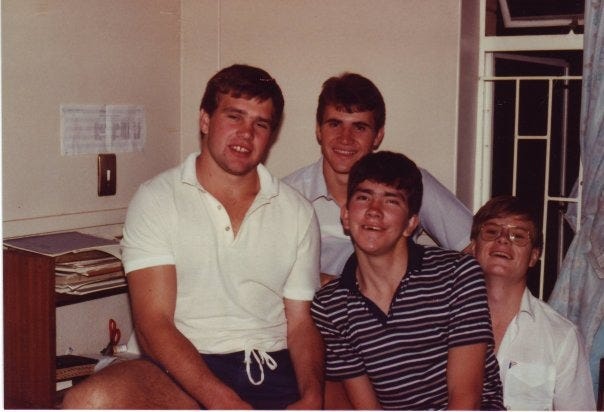
One fateful evening, as I roamed the schoolyard under the stars, I stumbled into their pack, en route to the stadium. Surprised to see me, they hesitated, then threw me an invite—a rare ticket to the chaos. I didn’t know it then, but I was about to witness the granddaddy of all karreskud encounters.
As we crept toward the stadium, one of the lads, eyes gleaming with anticipation, whispered about his dream target: a VW Beetle. “Perfect karreskud fodder,” he said. You could jump on the bumper, feet pounding, and if you had mates on both sides, you could make that Volksie hop like those lowriders in Mexico. The thought alone sent a ripple of laughter through the group.
Our first victim was a Mercedes, its windows steamed up like a sauna, heavy breathing fogging the glass. One of the skudders, a subject matter expert in the nocturnal mating habits of Homo Sapiens Skudders, peering in, declared with a smirk, “Hulle naai.” We launched our attack, rocking the car with gleeful abandon. But the guy inside? Unfazed. He kept at it, riding the moment like a cowboy at a rodeo, undeterred by our antics. I couldn’t help but be impressed by his commitment.
We had a number of other subject matter experts in the group. There was Nico, Lord of the Mags who knew a ton about car wheels and even a guy named Delport whose favourite prank was to shove a potato up the exhaust of a skudder’s victim. There was also Bes, who wasn’t a subject matter expert but was a langasem. His hand was in a splint as he had attempted to get a mulligan for a test by injuring his writing hand. He hand recently watched the film, Escape to Victory, where one of the players was purposely injured not to play.
Then, in the dim corner of the car park, we spotted our next mark: a Ford Cortina. That should’ve been a warning. You don’t mess with a Cortina man, he’s got grit, and probably something to prove. But we were young, invincible, and drunk on the thrill. We approached with military precision, surrounding the car and giving it a good shake. Big mistake.
The door flew open, and out came a furious driver, cursing like a storm and brandishing a pistol. The night exploded into chaos. He fired shots into the air, each crack splitting the silence like thunder. We scattered like roaches, legs pumping, hearts racing. I bolted for the nearest fence, only to realize it bordered the concrete sloot—a deep, treacherous trench carrying the river through Bloemfontein toward Loch Logan. No choice left, I leapt in, a few skudders beside me, and we ran, splashing through the shallow water for a kilometre until we reached a place to climb out, breathless and soaked. I was hauled out by a mate named Stokkies, who had ended up in the water of the sloot after attempting to tightrope walk a sewerage pipe over the sloot. For a moment there I though I’d be abandoned by my comrades, like when they left me dandgling on the pool gate like drying biltong when we went for an unathorized swim and Vollies rocked up.
Back at the hostel, we regrouped, counting heads. Wimmer and Stompie were the first to arrive back as their self preservation desire was the highest. Miraculously, no one was sporting bullet holes. Two guys, Gavin and Gustav straggled in late, pale as ghosts. They’d been nabbed by a passing police van, thinking they’d found safety. Instead, they were tossed into the back cage, roughed up a bit, and let go with a warning. They were delivered to the hostel by the cops. We laughed it off, adrenaline still buzzing, but we all knew we’d danced with the devil that night.
The housemaster, Vollies, was fast asleep, oblivious to our brush with disaster. We slipped back into our beds, the night sealing our secret. That was the granddaddy of karreskud—a tale of teenage bravado, a Cortina-wielding gunslinger, and a sprint through a concrete river that we’d never forget. As the years progress, the escapades of that night, stretch like “Visvang Stories.” Vleis, a keen fisherman himself is starting to claim that he could Karreskud 'n Hilux bakkie with his small toe.
The Forty Days Fiasco
The Forty Days celebration was a rite of passage at Grey College, a mischievous nod to the rock hit 40 Days, marking the final forty days of school. For us seniors, it was a chance to let loose, to etch our names in the annals of school legend with pranks that danced on the edge of rebellion. My mate, Dougie, and I had a plan that year, one that would make the quadrangle talk for weeks.
We had dodged the monotony of cadet marching, where wed trudge up and down roads and fields in formation, by volunteering at the local fire station. There, we learned the art of wielding fire hoses, the big ones, connected to the street hydrants, not the tame ones bolted to the school walls. It was practical knowledge, we told ourselves, but deep down, we knew it was a ticket to something grander.
When the Forty Days arrived, we waited for break time, when the quadrangle buzzed with students. As the crowd swelled, we unleashed the fire hose, its powerful jet sweeping across the quad like a rogue wave. Laughter and screams filled the air as students scattered, drenched and delighted, dodging the spray. It was chaos, glorious chaos, and we thought we were untouchable, until Dr. Michau Heyns, our headmaster, rounded the corner to investigate the commotion.
In a moment of reckless bravado, I swung the hose toward him. The water caught him square, soaking his suit. The quad fell silent, save for the hiss of the hose. His face turned thunderous, and with a barked order, he commanded us to shut it down and report to his office. My mate and I exchanged a look, part dread, part defiance, knowing wed crossed a line.
My history with Dr. Heyns wasn’t exactly spotless. Earlier that year, I’d published a cheeky photo of him in the school paper, hands in his pockets, captioned as him “playing pocket billiards.” It was a jab at his strict rule against students doing the same, a rule enforced with the sting of his cane. I suspected hed been biding his time, waiting for a chance to settle the score.
We stood in his office, the air heavy with anticipation, for a nerve-wracking twenty minutes while he changed into a dry suit. When he returned, he delivered a stern lecture about not getting “too big for our boots,” even with only forty days left. His words were sharp, but it was his actions that left a mark. He administered a caning unlike any other, one stroke for me, then one for my mate, alternating as we circled his desk. Six strokes each, the maximum, delivered with a precision that left no doubt about his displeasure.
As was tradition, we thanked him for the punishment, our voices steady despite the pain. Then, with tears stinging our eyes, we hobbled to the toilets. There, we filled a basin with cold water, desperately trying to soothe our throbbing backsides. The icy water offered little relief, but as we sat there, wincing and laughing through the pain, we knew we’d earned our place in the Forty Days lore.
That day, we learned more than just the mechanics of a fire hose. We learned about consequences, about the fine line between prank and peril, and about the stories that bind a school together. The quadrangle would dry, Dr. Heyns would move on, but the tale of the Forty Days Fiasco would echo through Grey College, a testament to our fleeting, fiery rebellion.
Years later a would meet Dr Heyns at a reunion. He face lit up in recognition saying I remember you. My ass gave an involuntary shudder in remembrance.
The Western Flyer Cyclist
From my earliest days on the farm, tearing down the dusty district road on my Golden Raleigh, cycling was my freedom. The wind in my face, the blur of grasslands and potato fields, it was my escape, my adventure. When I arrived at Grey College in Bloemfontein, that love didn’t fade. I convinced my dad to get me a Western Flyer, a cheap road bike that suited me just fine. I wasn’t about to be a boertjie with a clunky dikwiel. That sleek bike was my ticket to speed, and I became the notorious cyclist of Grey, zipping through the school grounds and the city streets with reckless abandon.
I’d race to the girls school, heart pounding more from the ride than the prospect of actually talking to anyone. When I got there, I’d be all teeth and no words, tongue tied and awkward. Unlike some of the self-proclaimed Casanovas in our ranks, I didn’t have wild tales to tell. One lad bragged about a tryst in the coal room, emerging covered head to toe in soot, his story as black as his clothes. My adventures were simpler, defined by the rhythm of pedals and the open road.
But not every ride ended in glory. One fateful day, I was speeding toward the poskantoor to withdraw some cash. The road was my playground, and I was flying until I hit a brick. At that speed, there was no saving it. I moered off, my face meeting the tar in a brutal slide. I broke a few teeth, bloodied and dazed, and limped back to the hostel. A hostel master, shaking his head, drove me to Universitas Hospital. The pain was sharp, but the embarrassment lingered longer. To this day, the lads never let me forget that spill, the day the notorious cyclist ate the road. Its a scar, a story, and a reminder: even the fastest fall sometimes.
The Gorgeous Jacqui Badenhorst
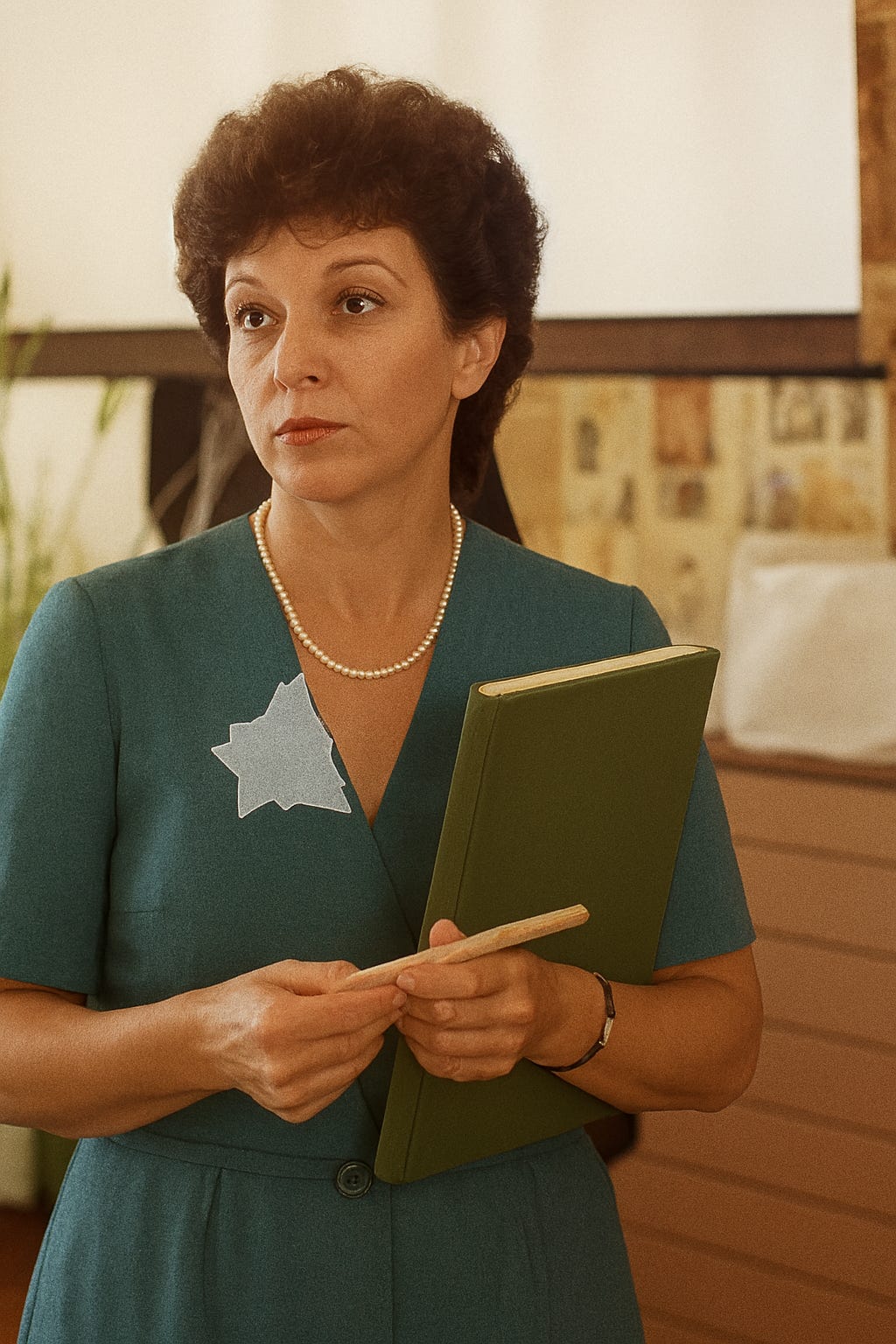
High school was a kaleidoscope of hormones, homework, and hero worship, and at the center of it all was our English teacher, Jacqui Badenhorst. She was no ordinary teacher—she was our Marilyn Monroe, brunette edition, with a magnetic presence that could stop a room. Always impeccably dressed, her outfits crisp and tailored, her makeup flawless, she was a vision of elegance in our dusty, Free State school. We were smitten, every last one of the boys.
The real show began when Jacqui turned to the green chalkboard. As she wrote, her chalk scratching out elegant cursive, her hips would sway in a subtle, rhythmic dance with each letter. It was mesmerizing, like a burlesque performance disguised as a lesson on Shakespeare or sentence structure. We’d sit, chins propped on hands, pretending to take notes while stealing glances at her graceful movements. The chalk dust would settle on her dress, and somehow, even that looked glamorous. Those bouncing bodacious buttocks were monuments like the granite boulders on the hill side of Oakvilla farm. Unforgettable.
But that sexy dance at the board wasn’t the thing that really made the testosterone flow. Her desk was in front of the board and when she read to us out of a text book or set work she would push her chair in at the desk and stand behind it. She would push her lower body hard against her chair and we would all be distracted. Not listening to one word she was reading. Occasionally there would be the grind up and down, like a stripper on a pole. To this day, I need a cold shower just thinking about it!
I was a diligent English student, but Jacqui’s class turned my effort into obsession. She had a way of making literature feel alive, like the words could leap off the page and into our lives. When she started using my compositions as examples for the class, I was over the moon. My stories, often scribbled late at night while at the hostel, were suddenly held up as the gold standard. I’d sit there, cheeks burning, heart racing, half-proud, half-mortified, and completely in love.
One day, Jacqui pulled me aside after class, her eyes sparkling with that warm encouragement she was so good at. “There’s a Navy essay competition,” she said, “and I think you should enter. Write a story with a naval theme. You’ve got the talent for it.” I didn’t know much about ships or the sea—our school was 600 kilometers from the nearest coast—but I wasn’t about to say no to her. I poured my heart into a story, weaving in the names of all my classmates as characters. It was a tale of adventure, camaraderie, and a touch of teenage bravado. I handed it in, hoping it’d make her proud.
Then came the curveball: I broke my leg. A clumsy tumble during a rugby match sent me back to our family farm to recover for a few weeks. Crutches, boredom, and the endless horizon of the countryside became my world. But when I hobbled back to school, still on crutches, I wasn’t prepared for what awaited.
The first hall period was a surprise. The principal called my name, and I limped to the stage, confused, the eyes of the entire school on me. There, in front of everyone, I was handed a certificate and an envelope stuffed with prize money. I’d won the Navy essay competition. The applause was deafening, echoing off the walls of the assembly hall. For a school better known for its sports trophies than its academic accolades, this was a big deal. I stood there, clutching my certificate, feeling like I’d just conquered the world.
From that day on, I carried myself a little taller, as if I had an extra feather in my cap. Jacqui’s belief in me had turned a farm cowboy into a momentary legend. My crush on her hasn’t faded with time, neither has the memory of her chalkboard dance and the pride she instilled in me.
Syssitia at Hamilton Hall
Hamilton Hall, a grand sandstone building designed by Herbert Baker, stood as the heart of our boarding school’s dining rituals. It was where the boys from Murray, Brill, and Leith hostels converged, three times a day, for meals that were as much about tradition as they were about sustenance. These were no ordinary meals; they were a syssitia, a communal affair steeped in ceremony, where we sat at long tables of twelve, each presided over by a prefect who commanded respect and order.
The ritual began outside the hall, where we lined up by house, standing in neat rows before marching in with military precision. Once inside, we stood behind our chairs, heads bowed, as a prayer was offered. A teacher would strike a gavel, its sharp crack signaling the start of the meal, and we’d sit, the oldest boys served first, a nod to the hierarchy that governed our world. Exactly twenty minutes later, the gavel would sound again, prompting us to stand, give thanks, and file out in an orderly exit.
Meals varied in quality. Breakfast and lunch could be hit or miss, but Sunday dinners were the highlight, a proper roast, the aroma of which filled the hall and briefly made us forget the monotony of hostel life. On less inspiring days, we were served what we dubbed “submarines”, a watery meat stew where you’d have to “depth charge” the pot with a spoon to unearth a elusive chunk of meat. If the food was particularly lackluster, some of us would sneak across the road to Angelo’s Roadhouse for a takeaway, a small act of rebellion against the kitchen’s offerings.
Angelo’s roadhouse has standard takeaway fare but something that was guaranteed to fill any hunger gap was their dagwood. It was the definitive greasy and cheesy loaded treat!
Tradition laced every meal with moments of camaraderie and mischief. Occasionally, a boy would rise to propose a toast—for a birthday, a special occasion, or just for laughs. One unforgettable toast followed the tragic news of a giraffe escaping from the Bloemfontein Zoo, only to meet its end under a lorry. That evening, as we choked down a particularly grim supper, a boy stood and proposed a mock toast “vir die kameelperd wat sy lewe gegee het vir ons aandete”, implying we were eating the unfortunate beast. The hall erupted in laughter, but the humor was short-lived. A lady staff member, face turning green, stormed out, and the boy who dared the jest was promptly caned.
Discontent with the food wasn’t uncommon, and once, we staged a full-blown eating strike, refusing to touch the dismal fare. The protest ended predictably: every one of us was caned, a painful reminder that defiance came at a cost. Punishment was part of the culture, as was the infamous “tea with the matrics.” During school breaks, tea and buns were served outside Hamilton Hall, but if the matrics invited you to join them, it wasn’t for pleasantries. These “invitations” were a forceful way of telling younger boys, especially the windgat ones—that their behavior needed correction. No one wanted that summons.
Tea itself was a race. To secure a cup and a bun, you had to sprint from class to be first in line; latecomers went empty-handed. For those with pocket money, there was an alternative: skipping tea altogether and heading to the tuckshop, a rickety old corrugated iron building, once a military hospital from the Boer War. There, a Coke and a donut offered a sweet escape from the rigid structure of hostel life.
Hamilton Hall was more than a dining room; it was a stage for rituals, rebellions, and the small moments that shaped our school days. The gavel’s echo, the taste of Sunday roast, and the sting of a cane for a cheeky toast, they’re etched into my memory, as much a part of growing up as the lessons we learned in class.
The Cast of Teachers
Our school was a vibrant tapestry of colourful teachers and mischievous antics, each leaving an indelible mark on my memories. Among them was Trevors Jordaan, a teacher and occasional rugby coach who seemed to embody joviality itself. His white shirt, a staple of his wardrobe, always bore the faint outline of a pack of Gunston cigarettes tucked into the pocket—a subtle badge of his laid-back demeanor. I’ll never forget the day in the bathroom when I glanced over and realized Trevors was, well, impressively endowed. It was the kind of moment that left you blinking in disbelief, a story whispered among us boys for weeks.
Then there was Dries vd Waal, the greenhorn teacher who arrived with a fresh face and ambitions to eventually take over as first team rugby coach from the legendary Lappies. One day, Dries was substituting for a teacher who was out sick. Paola and I, ever the provocateurs, decided to test his mettle with a heated political discussion, spouting the most outrageously liberal views we could muster. Dries, visibly shocked, marched next door to Trevors’ classroom to report our audacity. Moments later, he returned with Trevors in tow, who took one look at us, burst into laughter, and clapped Dries on the shoulder. “They’re winding you up, mate,” he chuckled. “It’s par for the course. You’ll get used to it.” Dries’ bewildered expression was priceless, and we reveled in our triumph.
Another unforgettable figure was Rock Ferreira, our Afrikaans and Latin teacher, always draped in a distinctive blue dust jacket. His classroom was a stage for our pranks, particularly Paola’s masterpiece: paper caricatures strung together with Prestik, expertly tossed to stick on the ceiling. They dangled there like trophies of our ingenuity, much to Rock’s bemusement, or perhaps he never noticed, lost in his world of declensions and Afrikaans idioms.
Our maths teacher, affectionately dubbed Seekoei for her plump figure, was actually named Truana. She presided over my domain of triumph, as maths was my forte. I consistently scored above 100% on tests, thanks to her habit of including a bonus question that I’d nail alongside every other problem. Those perfect scores were my quiet rebellion against the chaos of school life.
Then there was Religious Instruction, a period overseen by a teacher we called OS. He quickly gave up on teaching us anything about faith, as our class was a hotbed of arguments and debates. Instead, he let us run wild, turning the period into a playground for Paola and me to outprank each other. We’d devise elaborate schemes, knowing OS wouldn’t cane us like other teachers might. Those moments of unbridled mischief, free from the threat of punishment, were the heart of our schoolboy camaraderie.
These characters, Trevors with his cigarettes, Dries with his rookie earnestness, Rock with his dusty jacket, Seekoei with her bonus questions, and OS with his resigned leniency, wove the fabric of our school years. They were the backdrop to our pranks, our triumphs, and the stories we’d carry into adulthood, each one a thread in the rich tapestry of youth.
A Shattered Leg & a Haunting Connection
In 1982, my life took a dramatic turn on the rugby field at Grey College. I was 16, full of youthful bravado, chasing a rugby ball with everything I had. It was a crisp day, the kind where the grass smells sharp and the crowd’s cheers echo in your bones. Then, in an instant, a loose scrum collapsed on me. I felt a sickening crunch, and my world tilted. My leg was shattered, 27 pieces, the doctor later told me, as if it were a jigsaw puzzle they’d have to reassemble.
I tried to stand, driven by instinct and adrenaline, only to glance down and see my leg bent at a grotesque right angle. The sight hit me like a punch. I collapsed back onto the field, my fingers clawing at the grass, tearing it out in clumps as pain seared through me. The world blurred, shouts, teammates’ faces, the sky above, until I was loaded into an ambulance and rushed to Universitas Hospital. Morphine dulled the edges, wrapping me in a haze where time and faces melted together. Visitors came and went, their voices muffled, their identities lost in the fog of drugs. I was too out of it to recognize or remember them.
The medical bills piled up, but I was fortunate. The newly established Chris Burger Fund covered my expenses, a lifeline for a kid like me facing a long recovery. At the time, I didn’t think much of the fund’s namesake. I’d always assumed Chris Burger, a Western Province player, had died on the field at the Free State Stadium in 1980. It wasn’t until September, when I read about him, that the weight of his story hit me.
Chris Burger, only 28, had been in a similar scrum, on a similar field, just two years before me. A loose scrum collapsed, and he lay motionless, his neck broken. He told the doctor, “Dok, ek het geen gevoel in my bene en arms” (Doc, I have no feeling in my legs and arms). They carried him off on a wooden changing room door, a makeshift stretcher, to Universitas Hospital, the same emergency room where I’d been wheeled in. A neurosurgeon tried mild traction to relieve the pressure on his spinal cord, but it was no use. His teammates, including captain Morne du Plessis, visited him as he lay fully conscious, facing death with a courage I can barely fathom. He told a doctor, “I know my God. I am ready to go,” and passed away peacefully of respiratory failure early that Sunday morning.
Reading that, I froze. I had lain in the same emergency room where Chris Burger took his final breaths. The realization hit me like a wave, and I cried, hot, messy tears for a man I’d never met, for the fragility of it all, for the sheer luck that my injury, though brutal, hadn’t taken my life. His story, his courage, and the fund that bore his name became a thread connecting us across time, a reminder of how close I’d come to a different fate.
That fund, now part of the Players Fund, still supports injured rugby players. It’s a cause worth supporting, a way to honour Chris and others like him. If you can, please donate to www.playersfund.org.za.
The Brass Tap at Grey
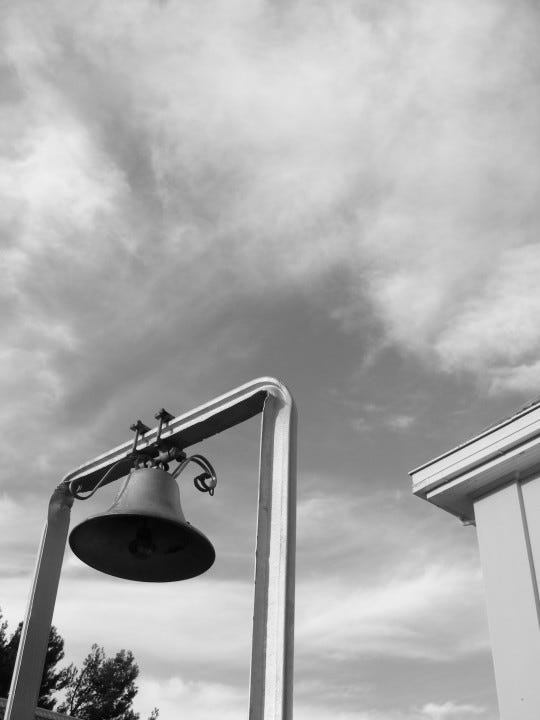
The main building at Grey stands as a sandstone splendor, its weathered facade a testament to time and tradition. Behind it looms the Reunie Hall, where sturdy beams overhead have borne witness to the legacies carved by generations of boys. Off to one side, the ou klok chimes, a ringing tribute to the fellowship that binds us across the years.
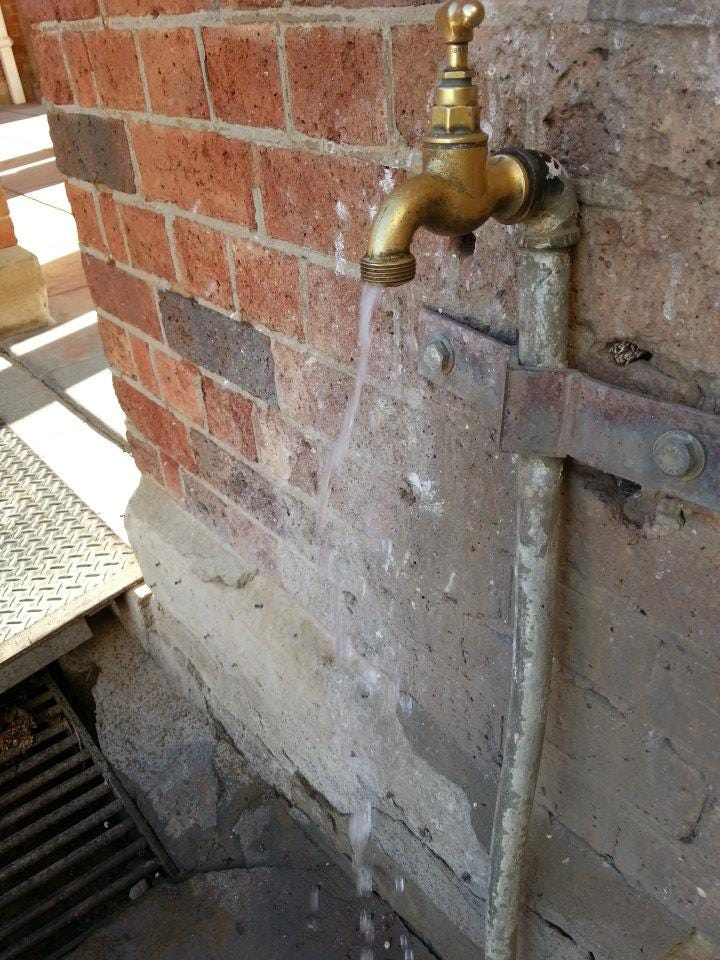
But for me, the heart of Grey lies in a quieter corner, unassuming yet unforgettable: a simple brass tap fixed to a pillar along the walkway to the side of the main building. It’s not grand like the sandstone arches or storied like the beams of Reunie Hall, but to me, it’s every bit as iconic. That tap, modest as it seems, holds a memory that outshines the rest.
No water ever tasted better than the water from that tap, drunk straight from the stream, open-mouthed and greedy. It was better than Perrier, better than anything bottled or refined. That water didn’t just quench thirst, it refreshed the body and soul, a cool rush of clarity that seemed to carry the spirit of the school itself. Maybe it’s just me, caught in the haze of nostalgia, but when I think of Grey, it’s that brass tap that brings the most joy, its memory sparkling like the water it poured.
When I need my soul replenished, I journey to that tap.