The Morning Patrol with MastelekđŸ’Ș

Stories of Mastelek who enjoys farming Boweia Volubilis

When Mastelek nearly took my Boet & Me out

My boet and I were the kings of pranks on our Natal Midlands farm, always scheming up ways to stir the pot. One evening, we outdid ourselves, rigging a ghost from old sheets tied to a foefie slide, with my battery-operated toy train tucked underneath. Its ghostly whistle was the perfect touch. We crept to the domestic workers’ quarters, knocked on the door, and launched our spectral creation from a nearby pine tree. The screams that erupted were music to our ears, and we collapsed under the pines, rolling with laughter, barely able to breathe.

But the joke turned sour fast. Bullets ripped through the branches above us, splintering bark and sending us scrambling. We burrowed into the dirt behind the tree trunks, hearts pounding, praying we’d make it out alive. When the gunfire finally stopped, we slunk toward the farm kitchen, only to run smack into Dad, his Lee Enfield .303 still in hand. His face was thunder. “Did you cause that screaming?” he demanded, thinking tsotsis had attacked the workers. We nodded sheepishly, and the sjambok came down hard. That night, we learned the hard way that pranks could cost more than laughs in the wilds of the Inyosi valley.

Wild FigWild Fig

Wild FigWild Fig

Ronald Bartels | LinkedIn | Instagram


The Art of Writing

Sparks of creation happen when you turn your life into words on a page. For me, writing these memoirs, and the thoughts that fed them, has been the most reliable therapy I have ever known. No couch, no hourly rate, no polite nodding from a stranger. Just me, the page, and the slow, merciless honesty when the mind starts exercising and stretching.

Talking is different. When you speak about pain, joy, regret, or triumph, the words leave your mouth and vanish into the air. They are shaped by the listener’s face, by the need to be liked, by the rhythm of conversation. You can skim, you can soften, you can laugh and change the subject in the same breath. The story stays half-formed, half-owned. But when you write, the words have nowhere to hide. They sit there in black and white, staring back at you. You see the contradictions. You feel the gaps where memory blurs. You cannot interrupt yourself or wave your hands to distract. Writing drags the truth out by the collar and makes it sit still until it is fully seen. That single difference, visibility, turns confession into excavation.

Some of us are born talkers; the world pours out of our mouths before it is properly sorted. Others, like me, are writers by temperament. We need the silence, the friction of pen on paper or fingers on keys, the tiny physical resistance that slows thought just enough for insight to catch up. Neither way is superior. Both are necessary. The brain is not a single-track machine. It is a symphony of senses, and the more instruments we play, the richer the music becomes.

Cognitively, writing lights up regions that speech alone leaves dark. You engage vision (the forming letters), touch (the pressure of the pen, the warmth of the laptop), proprioception (the movement of wrist and arm), and the deep internal orchestra of memory, emotion, and language all at once. Every extra sense you recruit strengthens the neural pathways. You are not merely recording experience; you are rewiring yourself. The more senses you involve, the more intelligent you become, not in the narrow sense of facts memorized, but in the wider, wiser sense of knowing your own mind. You grow larger on the inside.

That is why I learnt to trust both my rational thoughts and my beliefs with equal seriousness. Writing taught me they are not enemies; they are dance partners. The rational mind supplies the questions and the evidence; the deeper self, the gut, the intuition, supplies the felt sense of truth. When I write, I practice letting them speak in turn. I watch how a rational analysis of the past slowly softens into compassion once the intuitive voice is allowed. Over time, the two grow closer, until rational thought and gut feeling start finishing each other’s sentences. That is what I mean by developing intuition: not magic, but repeated, deliberate activation of the neural highways that connect head and heart.

So I write, often. And along the way I take photographs. Not polished Instagram moments, but raw, unfiltered slices of living: the outrides on eddy, the clouds, the way the sunlight crashes into my room. The camera is another sense. It anchors the words in light and colour and exact time. Later, when I sit with the photos, the memories leap into three dimensions. The neural pathways fire again, stronger. The story deepens.

If you are reading this and wondering whether your own life is worth writing down, let me tell you what the page has taught me: every life is. The act of writing it is the therapy. The slowing down is the growth. The seeing is the healing. Trust the process. Pick up the pen, open the camera roll, and begin. Your future self, clearer, calmer, more whole, will thank you for every word and every frame you dared to keep.

Ronald Bartels | LinkedIn | Instagram

Words

My life, woven from the dusty fields of Oakvilla farm in the Midlands of Natal to the quiet corners of introspection that followed, there’s a peculiar grounding known as “Calliope Syndrome.” It’s not a medical diagnosis you’d find in textbooks, but rather a whimsical label for a phenomenon that afflicts special individuals like me: the chronic mispronunciation of words encountered solely on the page, never in conversation. Named after the mythical muse of epic poetry, whose name itself is a trap, often butchered as “CAL-ee-ope” instead of the proper “ka-LYE-o-pee”—this “syndrome” arises when the written word outpaces the spoken one. You absorb vocabulary through silent immersion in books, building vast mental libraries, but without the auditory cues of everyday dialogue, those words emerge from your lips twisted, unfamiliar, and sometimes hilariously off-key. It’s the brain’s way of prioritizing comprehension over phonetics, a byproduct of solitary reading in a world that values the ear less than the eye.

For me, Calliope Syndrome took root in the fertile soil of my childhood isolation. Growing up on Oakvilla farm, my earliest interactions were a babel of languages, Zulu conversations with farm workers echoing across the fields, while my German and Afrikaans parents navigated our home in their native tongues. Then, in a pragmatic pivot to prepare us for school, they switched us to English, a language that felt as foreign as the distant cities it promised. As the youngest sibling, I was often left behind when my brother and sister went to class, marooned in a sea of solitude with only the farm’s rhythms and my imagination for company. That’s when the books found me, or perhaps I found them, dog-eared volumes stacked in corners, whispering adventures that drowned out the loneliness.

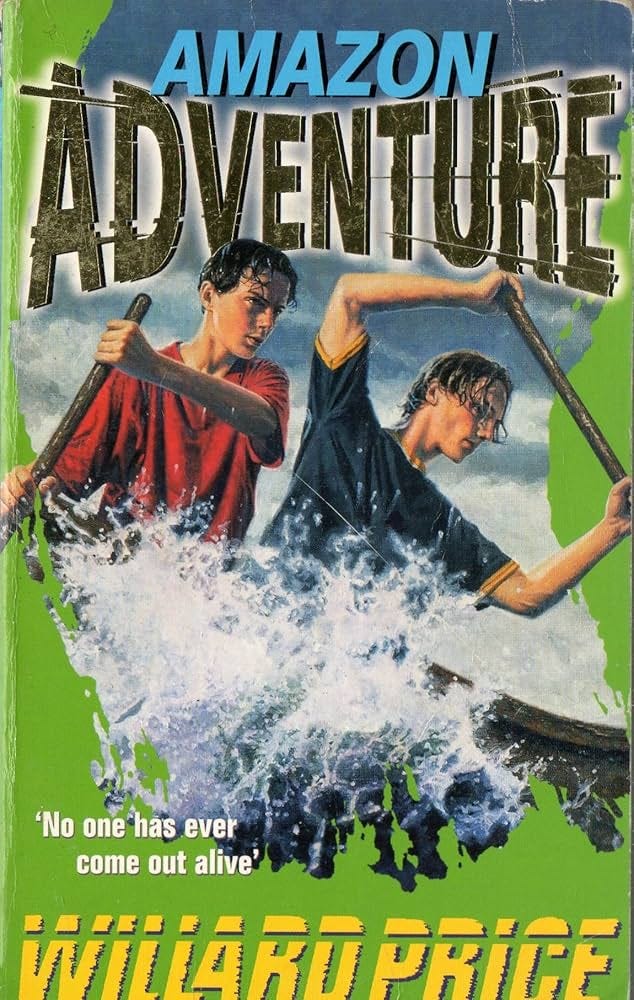
My reading began innocently enough, but it quickly became an obsession. Enid Blyton’s tales of secret seven and famous five were my gateway, their simple enchantments pulling me in. But I outgrew them swiftly, hungering for more. Willard Price’s adventure books transported me to exotic jungles and savannas, teaching me about wildlife and survival in vivid detail. The Hardy Boys fed my detective dreams with mysteries unraveled page by page. I devoured the Oxford Encyclopedia, its entries a feast of facts that expanded my world beyond the farm’s horizons. Then came Eugene N. Marais’s poetic observations on nature and the soul of the white ant, stirring a deeper philosophical bent. A even read some of the Good News Bible. Wilbur Smith’s sweeping African epics and James A. Michener’s historical sagas painted grand narratives of continents and cultures, shaping my opinions on history, resilience, and human folly. These weren’t just stories; they were my companions, my educators, my escape.

I’d read anywhere, anytime, perched in the dog box of our yellow VW Kombi on bumpy rides to school, the world blurring past as words held me captive. On holidays at my grandparents’ house, I’d sprawl on the cool floor, oblivious to family chatter, lost in paragraphs. Conversations faded into background noise; people might call my name, but I was elsewhere, ignoring the pull of the spoken world for the allure of the printed one. This immersion built my inner lexicon brick by brick, but it came at a cost, or rather, a quirk. Words like racist (you pronounce it ray-shist) or “Worcestershire” (a really common one that trips me up) slipped into my vocabulary unseen and unheard, only to betray me later in speech.

Now, well into my mature years, the echoes of Calliope Syndrome linger like a cherished scar. I still stumble over pronunciations, words that feel intimate on the page but alien on the tongue. Yet, I see it not as a flaw, but a blessing, a gift forged in those quiet hours of self-discovery. It reminds me that true expression often lies in the written form, where ideas flow unhindered by the clumsiness of sound. In a life shaped by farms, languages, and the relentless pursuit of knowledge, this syndrome is my badge of honor: proof that books didn’t just inform me, they transformed me, one mispronounced syllable at a time.

Kath’s parents were teachers and would constantly correct my pronunciations, especially at the syssitia. Ironically, they did not understand the syndrome. My brain was hardwired and could not relearn. I just repeated the offense. They just corrected me again. I cannot even recall what those words were, they get deleted.

Ronald Bartels | LinkedIn | Instagram

Dealing with gaslighting

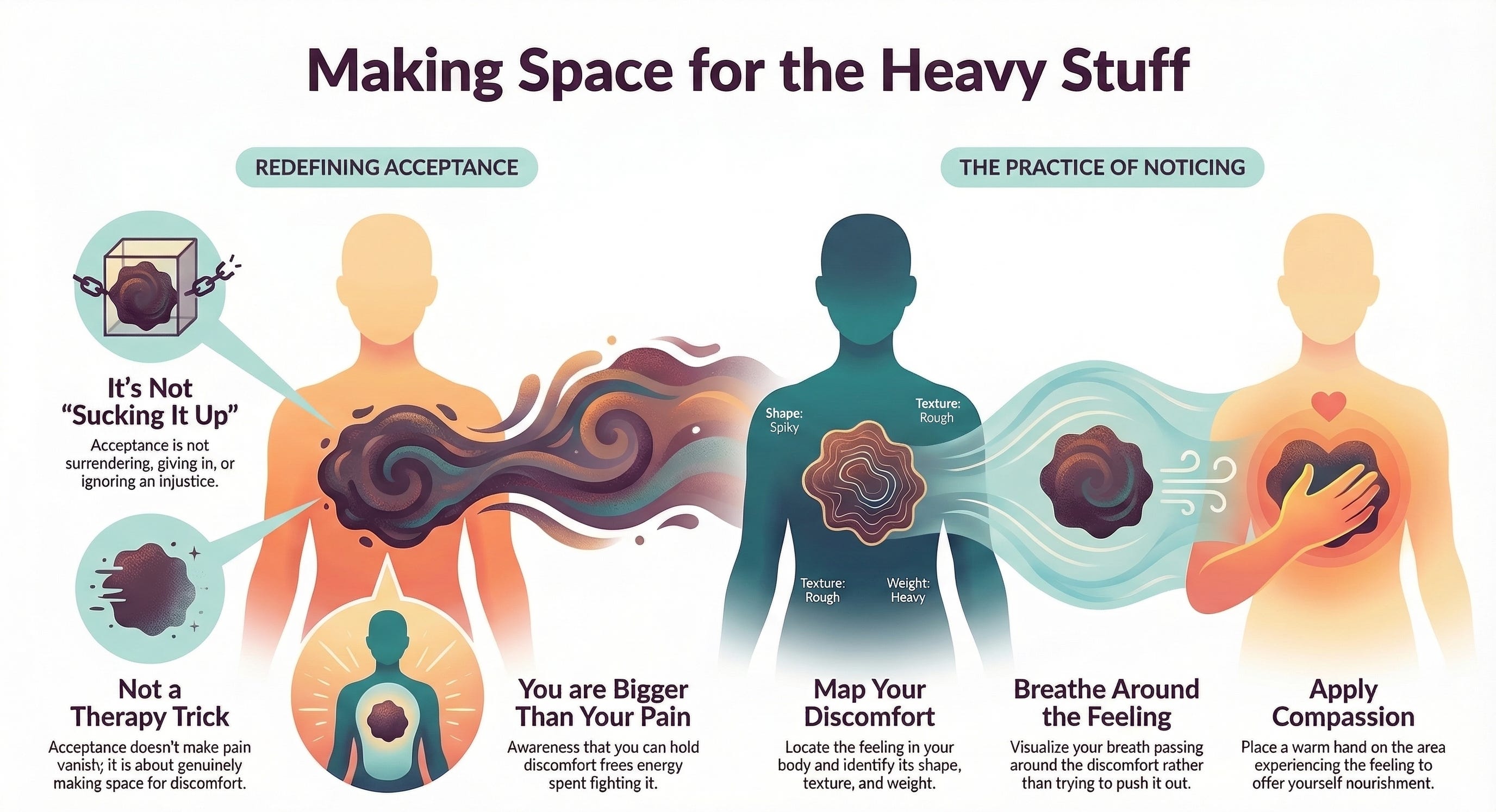
The extract below explores the profound distinction between passive resignation and the authentic practice of acceptance regarding emotional or physical distress. The author argues that true acceptance is not a deceptive strategy to eliminate pain, but rather a process of consciously creating space for uncomfortable sensations without trying to alter them. By utilizing mindfulness and breathing techniques, individuals can observe their internal struggles with a sense of curiosity and compassion instead of resistance. This shift in perspective reveals that a person is stronger than their discomfort, allowing them to acknowledge its presence without being consumed by it. Ultimately, the source suggests that halting the internal fight against pain preserves vital energy that can be redirected toward meaningful life goals.


From the book: “Holding the Heavy Stuff: Making Space for Critical Thoughts and Painful Emotions” by Ben Sedley.

“Acceptance is a word that seems to be used everywhere now. Sometimes, it’s used dismissively. People might tell you to just ‘accept it’, meaning ‘suck it up’, ‘ignore it’, or ‘stop talking about it’. Others were taught to associate acceptance with surrendering, giving in, or putting up with injustice. I’m sorry if you’ve had this experience.

Acceptance can also be confused with tolerating a feeling. You might tell yourself you can ‘put up’ with a feeling, as long as it doesn’t get too intense or stick around for too long.

Other times people try to treat acceptance as a clever therapy trick. If you can just ‘accept’ this sadness or anxiety or trauma or chronic pain, then you won’t have to have it anymore. Wouldn’t it be great if this were true? If you could just use acceptance as a tool to avoid accepting what you’re feeling? But acceptance isn’t a trick or a technique. It’s about genuinely making space for discomfort. So, why on earth would we want to learn to hold our internal pain? It’s heavy. It hurts. And right now, you have it whether you want it to be there or not (although I’m not making any statement about whether you will always have it).

So, let’s use our curiosity and noticing skills to get to know our pain.

Take in a breath.

As you breathe in, what does it feel like to be breathing in?

As you breathe out, what does it feel like to be breathing out?

Now have a look around inside your body. What feelings, emotions and sensations can you notice? Are there any that feel raw or uncomfortable? Let’s spend some time with those. Don’t try to remove them or change them; rather, notice them with curiosity. Like you’ve never felt these feelings before.

Where do these feelings sit inside your body? How big are they? Do they have a shape? Do they have a particular texture or colour? Are they jagged or smooth? Are they heavy or light?

As you observe these feelings, are you also able to observe your breath? Watch as your breath comes into your body, passes around the feelings wherever they are sitting, and goes out of your body again. Let your breath do whatever it needs to do to care for you and nourish you. Observe this for a few cycles of breath.

Your mind might tell you that there is no room inside you for these feelings. Yet, what is your experience telling you right now? You can breathe around these feelings. There is room inside you for these emotions and sensations, even the feelings that are uncomfortable and you really wish weren’t inside you. Notice your breath is able to pass around these feelings too. Keep coming back to your breath. You’ve got this.

Now I invite you to take a warm compassionate hand and place it on the part of the body that is experiencing these feelings. What does it feel like to have the feelings and to have the breath and to have the warmth and compassion? Can you observe them all? Observe this as you breathe in and breathe out. Then slowly, when you’re ready, take three more breaths before bringing your focus back to the world around you.

Now, take some time to notice what it was like to do that. What was it like to observe your discomfort rather than fight it? To see the discomfort for what it is rather than to listen to your mind telling you that it shouldn’t be there or that you won’t cope if it continues?

Did you notice that there is room inside you for the discomfort? For the emotions or judgemental thoughts? Even for those things you really wish that you didn’t have to be holding? You are bigger and stronger that any of these thoughts or emotions or sensations or urges or memories. Knowing that doesn’t stop it hurting, but maybe the awareness that you can hold it frees up some energy that you would have spent fighting it, and allows you to do things that matter to you.”


My personal opinion is that these things reside inside your body around the stomach, the second brain.

Ronald Bartels | LinkedIn | Instagram

Marais’ broader vision of a group soul remains unverified, yet perhaps still tantalizingly plausible

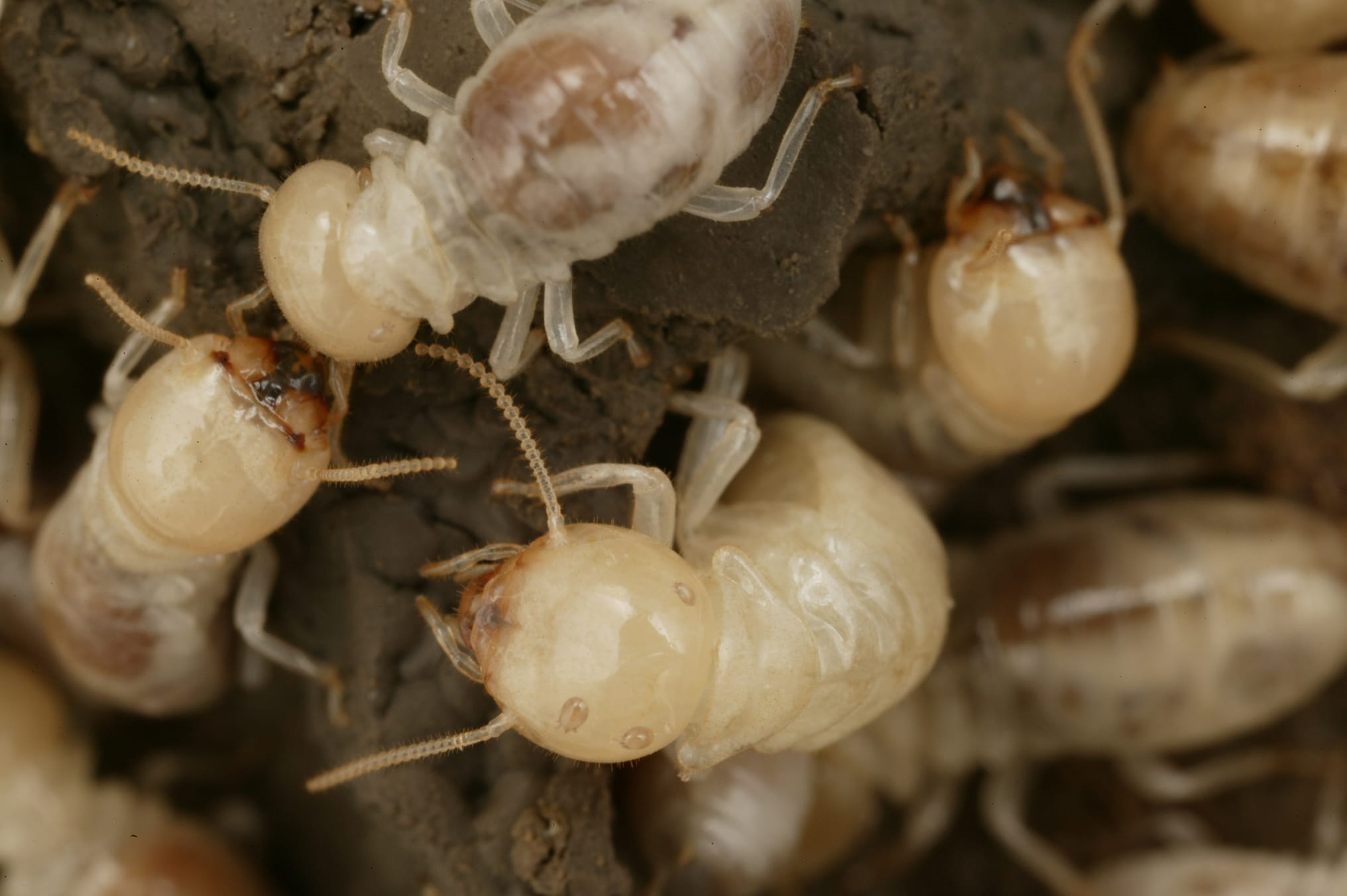
Long before modern science unraveled the intricate symbiosis between fungi and termites, Eugene N. Marais wandered the dusty mounds of South Africa, observing with keen eyes and a poetic mind. In The Soul of the White Ant, he proposed a daring, and some would say mystical idea: a termite colony is more than a collection of insects; it is a single composite organism, a living animal where individual termites are akin to cells, and the mound itself forms the body.

While contemporary research has confirmed the central role of fungi in termite nutrition and colony health, Marais’ broader vision of a group soul remains unverified, yet perhaps still tantalizingly plausible.


Fungus & the Superorganism

Many termite species, particularly the fungus-growing termites that Marais studied, cultivate fungus gardens within their mounds. These gardens are far from decorative; they are the colony’s digestive organs.

Here’s how the process works:

  • Worker termites gather plant material (wood, grass, or leaves) and chew it into a pulp.
  • This material is inoculated with fungal spores, often from the genus Termitomyces.
  • The fungi break down complex cellulose and lignin, substances termites cannot digest efficiently on their own.
  • The colony then feeds on the fungal mycelium and the partially digested substrate, a nutrient-rich fungus comb.

In Marais’ metaphor, the fungus gardens are analogous to the stomach, liver, and intestines of a single organism, processing food for all. Workers and soldiers act like blood cells, transporting nutrients and defending the colony. The queen, meanwhile, serves as the brain, orchestrating the colony’s growth and reproduction.


A Group Soul?

Where Marais truly diverged from modern entomology was his speculation about the colony’s collective psyche. He observed how termites meticulously tended their fungus gardens, balancing growth and harvest with remarkable precision. To him, this was evidence of a unifying “soul” that guided the colony beyond instinctual behavior.

Today, scientists describe termite colonies as superorganisms, coordinated through chemical signals, pheromones, and social behaviors—but they stop short of endorsing a literal “soul.” Marais’ vision remains in the realm of philosophy: an early attempt to capture the emergent intelligence and unity of complex life in metaphorical terms.


Insights Ahead of Their Time

Modern research validates the fungus-termite symbiosis Marais described: the intricate balance between fungal cultivation and termite labor is essential for colony survival. Yet, science has not, and perhaps cannot, confirm or refute the existence of a group soul.

Maybe Marais’ insights were not just ahead of his time, they may still be ahead of ours. His work invites us to consider life not only in terms of cells and biochemistry but also in relationships, coordination, and collective intelligence. Even in an age dominated by molecular biology, there is room for wonder at the possibility that life, in its many forms, may have layers we have yet to fully understand.


Final Thought

Whether you take the “soul” metaphor literally or as poetic philosophy, The Soul of the White Ant challenges us to see termite colonies (and perhaps all superorganisms) as more than the sum of their parts. In the silent, bustling chambers of a termite mound, there is a story of cooperation, complexity, and mystery that science continues to explore, and Marais’ vision continues to inspire.

Ronald Bartels | LinkedIn | Instagram

My Greatest April Fools’ Triumph (That I Almost Missed)

Every year on April 1st, the internet fills with the usual suspects: fake product announcements, photoshopped disasters, and companies pretending they’ve pivoted to selling socks or something equally ridiculous. Most of them land with a thud and disappear by lunchtime.

But the truly legendary pranks? They don’t scream “April Fools!” They whisper it... and then let the world do the screaming for them.

This year, someone pulled off a doozy. They managed to get the White House switchboard phone number showing up on certain Android devices (especially Pixels) as “Epstein Island.” Reporters dialing in got the surprise of their lives. Google quickly killed the edit and blocked the culprit, but for a brief, glorious moment, the prank was perfect, timely, topical, and technically cheeky. It was the kind of Google hacking that makes headlines without anyone getting arrested.

It felt eerily familiar.

Because a decade ago, I did the exact same type of thing. And it became my greatest prank ever.

The Setup

Back in 2017 (or thereabouts, the details are fuzzy in the best way), I decided to play with Google Maps. South Africa was in the middle of the State Capture saga, the Guptas were everywhere in the news, and Saxonwold was basically the punchline of every political joke. Brian Molefe’s infamous “Saxonwold shebeen” excuse had already entered local folklore.

So on April 1st, I made a small, anonymous edit. I pointed the address for “The South African Presidency” to Saxonwold Drive, Randburg, right in the heart of Gupta territory. Nothing too on-the-nose at first, but close enough that anyone paying attention would get the joke. It was a classic Google Maps business/listing hack: suggest an edit, wait for moderation (which was... relaxed back then), and cross your fingers.

I hit submit, chuckled to myself, and went about my day.

Then... nothing happened.

No immediate outrage. No viral tweets. No frantic calls from the Union Buildings. I figured it had either been caught instantly by Google’s filters or it was too subtle. “Ah well,” I thought. “Better luck next year.” I completely forgot about it.

The Slow Burn

Two weeks later, I’m driving through Johannesburg, radio tuned to 702. The headlines come on, and suddenly I hear it:

The South African Presidency’s address on Google Maps had been changed to a location in Saxonwold, right near the Gupta compound. Some outlets even called it the “Saxonwold shebeen.” It was front-page news. Papers like MyBroadband, The Citizen, and News24 ran stories. People were losing it. Google eventually noticed and quietly moved the listing back to the Union Buildings in Pretoria.

I nearly swerved off the road laughing.

It wasn’t discovered on April 1st. It simmered. Someone else stumbled across it days later, the media picked it up, and suddenly the entire country was talking about how the Presidency seemed to have relocated to a dodgy shebeen in Saxonwold. The timing was accidental perfection, it landed right in the middle of the political fever pitch, making the joke hit ten times harder than if it had exploded on the day.

I sat there in the car, anonymous and triumphant, thinking: That was me. I did that.

No one ever traced it back (as far as I know). I never claimed credit publicly. It was pure, clean chaos, the best kind.

Why This One Was Special

Most pranks are loud and obvious. They beg for attention. This one was elegant. It used a tool everyone trusts (Google Maps) to subvert something serious (the seat of presidential power) in a way that played perfectly into existing South African satire. It didn’t need a big announcement. The absurdity spoke for itself.

The 2026 White House “Epstein Island” prank is cut from the same cloth: a targeted edit that slips past the gates and lets reality do the heavy lifting. These Google hacks work because they feel plausible for just long enough to make people do a double-take. In a world drowning in obvious fakes, the best April Fools jokes are the ones that make you wonder, even for a second, if it might actually be real.

Lessons from a Master Prankster (Me, Apparently)

  1. Timing is everything — but sometimes delayed timing is even better.

  2. Subtlety beats spectacle. Let the audience connect the dots.

  3. Strike where people least expect it — official listings, maps, phone numbers. Places that feel too boring to prank.

  4. Never confess immediately. Let it breathe. (Though writing about it a decade later on Substack is probably safe.)

If you’re planning your own April Fools mischief this year or next, remember: the greatest pranks aren’t the ones that trend on the day. They’re the ones that make the news two weeks later, when the perpetrator is already sipping coffee and grinning like an idiot in traffic.

Mine did exactly that. And I’ve been chasing that high ever since.

What’s the best prank you’ve ever pulled off — or fallen for? Drop it in the comments. I’m always looking for inspiration.

(And Google, if you’re reading this
 no hard feelings. It was just a bit of fun.)

Ronald Bartels | LinkedIn | Instagram

The painting that was comfort & not despair
Over the weekend I searched the house for the hidden soul.

Not casually. Properly.

Cupboards were opened with intent. Drawers slid out & stayed out. I stood longer than usual in front of objects that had long ago faded into the background of my days. The antiques got special attention. They always do. Old things carry stories the way trees carry rings, quietly, without announcing themselves.

I was convinced I’d find it in something like that samovar that went to live with Meggy. That one had presence. You could feel it listening, even when it said nothing.

But this house?

Nothing.

Not a whisper. Not a shift in the air. Just the low hum of familiarity.

On top of a cupboard, one I hadn’t bothered with in years, I found an old book of coins. It had been thrown over the wall by JO when he upped sticks to the States. No ceremony, no goodbye. Just a quiet toss & into my life.

I stood there for a moment, holding it, wondering if that was how souls moved too. Not with drama, but with momentum.

Maybe there’s something in here, I thought.

I took it through to the dining room, sat down, and opened it. Page by page. Coin by coin. Maybe, I thought these coins can be made into some art!

And then


“Does she have a blanket?”

The words didn’t arrive so much as settle. They hung in the air behind me, as if they had always been there & I had only just tuned into the right frequency.

I turned.

The cuckoo clock was silent. I hadn’t pulled up the acorn weights in days. It looked as lifeless as anything can look while still pretending to be alive.

But next to it


There it was.

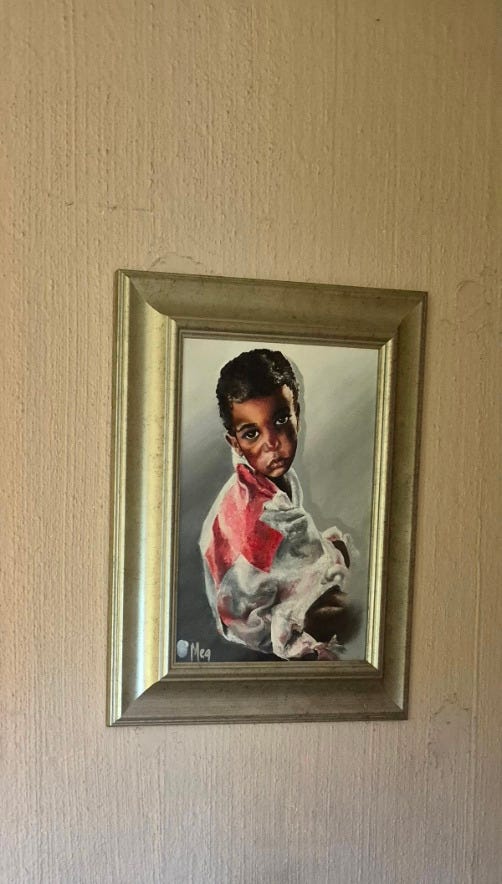
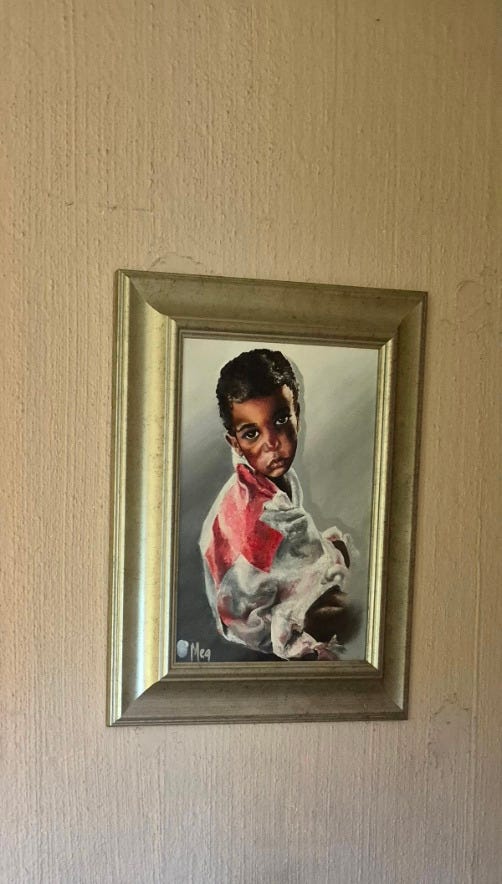
The painting I called Hunger and Despair.

It had been there for years. Meggy’s work. Her name in the bottom left corner, marked with that familiar fingerprint, her way of saying this is mine, and I was here.

I walked past it every day.

Every single day.

And I never saw it.

Not really.

I stood up & moved closer.

The painting didn’t change, but I did.

It wasn’t about hunger. It wasn’t about despair.

It was a little girl. Curled into something soft. Something protective. Something warm. A blanket, not just fabric, but a boundary between the world & whatever it was that frightened her.

It wasn’t absence.

It was comfort.

It wasn’t loss.

It was refuge.

I had been wrong all these years. Not slightly wrong, completely.

“You’re the one,” I said quietly. “The one who listened to the samovar?”

“Yes.”

The voice didn’t echo. It didn’t need to. It was steady, like it had been waiting a long time to be heard properly.

“Oh,” I said, because there wasn’t much else to say to something you’ve ignored for years. “I’ve been searching for you.”

“You walk past every day,” it said, not unkindly. “And see right through me. Never acknowledging.”

There’s a particular kind of embarrassment that comes with that sort of truth. Not sharp, just heavy.

“Sorry,” I said. “I didn’t realise.”

“It’s okay,” it replied. “You work hard.”

I let that sit for a moment.

“I thought this painting was about despair,” I said. “All this time.”

“It’s about what holds you together when things fall apart.”

I nodded.

“Everyone needs a blanket,” it added.

“That is true,” I said.

We stood there, me in the room, it in the painting, both of us somewhere in between.

Then a thought came, simple & obvious in the way good ideas often are.

“Do you want to go on a holiday?” I asked. “Visit the samovar.”

There was a pause, not hesitation, just consideration.

“Yes,” it said. “That would be perfect.”

I looked around the house. At the cupboards I had opened. At the objects I had inspected like a detective who’d forgotten what he was looking for.

The answer had been on the wall the whole time.

“I’ll go find a box,” I said.

Because some things don’t need to be uncovered.

They just need to be seen.

Ronald Bartels | LinkedIn | Instagram
(Down by the Cycle Shop)

Verse 1 She stood in the cycle shop down by the corner Everyone called her Pretty Bianchi I went to the cycle shop down by the corner Just for a look at Pretty Bianchi

All of my cranking, wanted to give her As soon as I saw her, Pretty Bianchi She stood in the cycle shop down on the corner I wanted to ride her, Pretty Bianchi

Verse 2 Her frame was exciting, her paint it was celeste The wheels were inviting and my heart she’s stolen! Italian steel shining, Campagnolo gleaming The curves were so perfect, my soul she was claiming

Chorus Now we’re together, me and Bianchi Now and forever, me and my Bianchi She stood in the cycle shop down by the corner But now she’s my baby, Pretty Bianchi

Bridge I polished her daily, I tuned her with care We ride through the mountains, we fly down the roads No need for a girlfriend, she’s all that I need My beautiful Bianchi, my Italian dream

Final Chorus She lived in the cycle shop down by the corner Everyone called her Pretty Bianchi Now I am with her, my P.B. That’s what I call her, my Pretty Bianchi

She gave me her gears then, believe me Your promise will never bother Bianchi is mine now! Pretty Bianchi
 down by the cycle shop!

Ronald Bartels | LinkedIn | Instagram
Religious Apartheid | Separation & segmentation

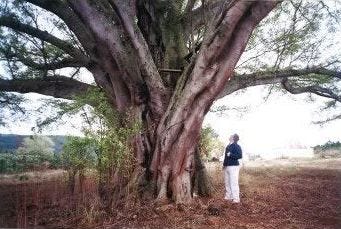
In the valleys of Kranskop, where the mist clings to the hills like unspoken regrets, my family’s story with kwaSizabantu, or KSB, as it’s known, unfolds like a wound that never quite heals. It began not with the mission’s polished facade of revival and redemption, but with the brutal blade of shunning, a practice so ingrained in KSB’s doctrine that it severs bloodlines as easily as one might clip a withered branch. Shunning isn’t mere disapproval; it’s excommunication from the soul, a deliberate isolation enforced under the banner of purity and obedience to God. It a religious Apartheid, a disgraceful and unholy separation. To leave, to question, to simply choose a different path is to invite the silence of the forsaken. And in our family, it struck first at the heart of my father, Mastelek mkulu.

The ripples of Bible House, a fervent evangelical group led by the charismatic Anton Engelbrecht, reached and touched our home. My father’s siblings, drawn by promises of spiritual fire and communal living, threw their lot in with the movement, which would later morph into the sprawling KwaSizabantu Mission under the iron guidance of Erlo Stegen. Bible House preached instant obedience, confession of sins in excruciating detail, and a hierarchy where leaders spoke as the voice of the divine. But for those who resisted, like my father, the cost was exile. Overnight, he became a ghost in his own bloodline. Phone calls went unanswered; visits were met with locked doors and averted eyes. “It’s for your soul” they said. “You’re choosing the world over Jesus.” He didn’t join, not out of rebellion, but because his faith was quieter, less armored in absolutes. My mom and him raised us with something sorely lacking at KSB, integrity and true strength in faith. Faith was never blind obedience.

A decade passed before reconciliation came, bittersweet and incomplete. Bible House dissolved into KSB, as Erlo Stegen consolidated power on a 140-hectare farmstead bought for the cause using ill gotten gains. My father was extended an olive branch as his family reconciled, leaving Bible House but not joining KSB. He was the prodigal. But you see, he had been right all along. By then, KSB had grown into a self-sustaining empire: schools, farms, even a bottled water brand called aQuellĂ©, drawn from the mission’s own springs and marketed as “purity in every drop.” It had ballooned into a network of control, where obedience wasn’t optional, it was the air you breathed.

The shunning didn’t fade with time; it calcified. I saw it devour my cousin Karen, a girl I’d known growing up. Married to Albu van Eerden, both deep in KSB’s fold, she turned inward to embrace the devil by shunning her own children. Tabitha, her daughter, bright, questioning Tabitha, who dared to seek a life beyond the mission’s walls, was cut off without ceremony. No birthday calls, no hospital visits during illness, just the void. Karen’s other children fared no better; one by one, they were deemed worldly, their imagined sins confessed by their mother publicly before the congregation. And then the wall went up. What drives a mother to this? To stare into the eyes of her flesh and blood and see only a threat to her salvation? It’s not a love of Jesus, its the twisted teachings of KSB, a love that demands you “die to self,” even if it means burying the living. Witnesses before South Africa’s Commission for the Promotion and Protection of the Rights of Cultural, Religious and Linguistic Communities (CRL) have described it as systemic: families torn asunder, weddings boycotted, children orphaned by decree. One ex-member recalled parents refusing to attend their child’s marriage because it defied the mission’s courtship bans, no dating, no autonomy, just arranged unions blessed by the elders. In KSB, love is conditional, doled out like rations in a siege.

At the helm of this machine stood the Stegen brothers: Erlo, the founder, a missionary whose fake Zulu revival birthed the mission, and Friedl, his quieter but no less commanding sibling, who preached “instant obedience” from pulpits echoing with the ghosts of German pietism. Their rule was absolute, laced with secrecy that one critic, their own brother Manfred, likened to “Nazi-style” control, decisions shrouded, dissent crushed. Manfred, once a pillar, grew disillusioned, peeling back the layers of abuse: forced confessions that veered into voyeurism, underpaid labor on mission farms, and a doctrine that policed thoughts as fiercely as actions. For his candor, he was shunned, barred from the community he helped build, his warnings dismissed as betrayal. Even Friedl, in his nineties and confined to a wheelchair, wasn’t spared the blade. Accused of straying from the “Way,” he was isolated by the very obedience he once demanded, wheeled away from fellowship like yesterday’s sermon. The irony was poetic, almost karmic.

Karma, in our family’s telling, runs deeper still. Friedl’s wealth, stemmed from a betrayal that scarred another lineage: the Witthofs, a vulnerable German family whose patriarch’s will he assisted in executing. The widow, grieving and isolated, trusted him implicitly. But Friedl, with executor powers unchecked, transferred their fertile farms into his own name, a brazen heist that funneled resources into his own and Erlo’s growing empire. It echoed an earlier theft: Bible House’s coffers, siphoned by Hogart Joosten in the movement’s chaotic infancy, providing the seed money for KSB’s expansion. These weren’t footnotes in revival history; they were the foundation stones, built on wool pulled over grieving eyes. Friedl’s late-life shunning? To us, it was the universe’s quiet accounting, a reminder that no throne of piety stands forever.

Today, as scandals swirl, allegations of sexual assault, child labour, and cultic control probed by commissions and ignored by corrupt police, KSB soldiers on, its aQuellĂ© bottles gleaming on shelves despite attempts at boycotts. The mission’s defenders cling to a narrative of salvation, but I see the cost: fractured families, silenced voices, a society where “helping people” means breaking them first. To those who still quench their thirst with aQuellĂ©, who tithe to this golden calf, take a hard look. Is this the obedience Jesus craved, or the cage we build when faith turns feral? My father’s reconciliation with his family taught me grace is possible, but only if we see the shadows. Shunning isn’t divine; it’s the cult’s cruelest chain. And in breaking it, we reclaim not just our families, but our souls and humanity.

Ronald Bartels | LinkedIn | Instagram
Tailgating

Growing up in a family with ties to the cult of kwaSizabantu (KSB), I found myself dragged into some truly peculiar social obligations. My cousins on my dad Mastelek’s side were die-hard devotees of KSB—where “Reverend” Erlo Stegen reigned supreme as the spiritual patriarch. He wasn’t just a preaching bible puncher; he was the architect of lives, dictating everything from daily routines to eternal destinies. And when it came to matrimony, Erlo’s word was law. These weren’t your typical love stories blooming from stolen glances or whirlwind romances. No, sir—these unions were meticulously arranged under his watchful eye, with a strict code that forbade any premarital “shenanigans,” as my dad would euphemistically put it. Courtship was a controlled affair: supervised interactions, no physical contact beyond a chaste handshake, and certainly no funny business that might sully the purity of the occasion. It was all about divine alignment, or so they claimed.

My parents, bless their skeptical souls, weren’t exactly enthusiastic participants in this fervor. They accepted the wedding invitations more out of morbid curiosity than genuine familial duty—a chance to peek behind the curtain of this ultra-strict world without committing to its doctrines. “Need to see what they are up to,” my dad would quip under his breath. And when these events coincided with my holidays, I’d inevitably tag along, wondering what fresh oddity awaited.

I remember one wedding in particular, when I was already knee-deep in my university days at Maties, feeling worlds away from the rigid piety on display. The ceremony was held at Claridges, that elegant old Bible House venue where these austere KSB affairs occurred. We sat through the vows, a sea of somber faces nodding in approval as the couple pledged their lives under Erlo’s orchestrated blessing. No frills, no flair—just scripture, hymns, and a palpable sense of enforced holiness.

After the “I dos,” the congregation filed into the adjoining hall for the reception. That’s when my dad, ever the opportunist, leaned over and muttered, “Come on, son, help me check the tires on the car.” I shot him a puzzled look—our tires were fine—but I followed anyway, leaving Mom to scout out our table for the impending meal. Now, these KSB weddings were bone-dry affairs; alcohol was taboo, a sinful indulgence that had no place amid the godly gathering. Lemonade, tea and maybe some grape juice were the strongest libations on offer.

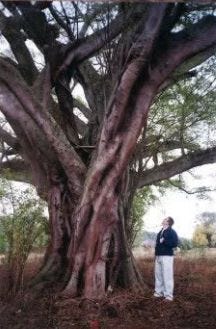
We slipped out to the parking lot, and Dad popped the boot of our car. He peeled back the mat covering the spare wheel, revealing his hidden stash: a bottle of fine Scotch whisky and a couple of tumblers tucked away like contraband. “Just a quick toast to survival,” he winked, pouring us each a generous tot. There we stood, tailgating in the shadow of the venue, sipping the amber liquid and chuckling about the irony of it all—the puritans inside preaching temperance while we savored our secret rebellion.

Refreshed and a tad warmer, we rejoined the festivities for the main course. Mom eyed us suspiciously, her knowing glance saying she’d pieced it together without a word. The meal dragged on with speeches extolling Erlo’s wisdom and the couple’s virtuous path. But after the plates were cleared, Dad nudged me again: “Think we should double-check those tires, just to be sure.” I nodded, playing along, but then Mom piped up, “I’m coming with you this time.” I was gobsmacked—Mom, the picture of propriety, joining our covert operation?

Back at the car, the plot thickened. Dad hadn’t just planned for us; he’d smuggled a bottle of sweet Hanepoot wine especially for her. We poured another round—Scotch for us, wine for Mom—and there we were, the three of us, laughing quietly in the boot’s glow, toasting to our little family insurgency. It was a moment of pure, unadulterated joy amid the starchiness. We returned just in time for dessert, our spirits lifted far beyond what any sermon could achieve.

Looking back, we were undoubtedly the happiest attendees at those weddings. While the KSB faithful celebrated their arranged bliss with hymns and handshakes, our family found our own brand of merriment in those parking lot interludes. Erlo Stegen is turning in his grave.

Ronald Bartels | LinkedIn | Instagram